


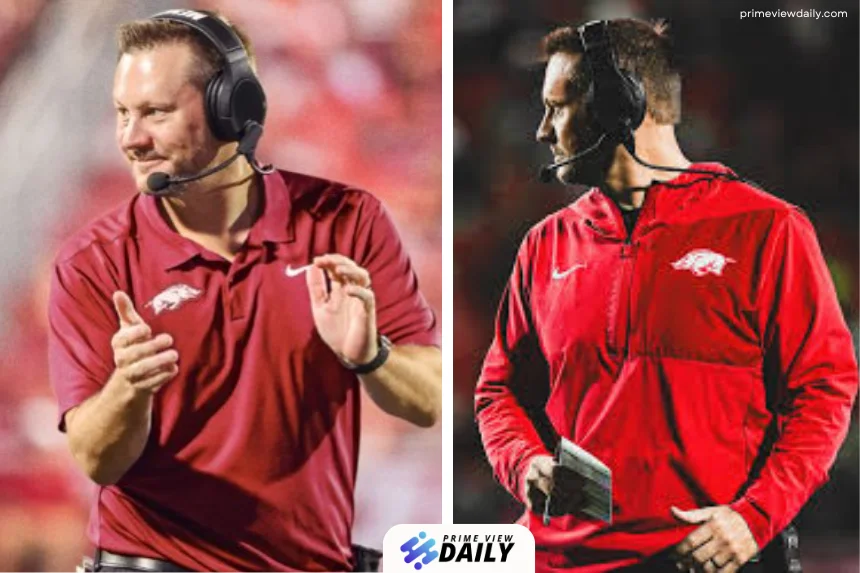
Ryan Silverfield is the head football coach of the Arkansas Razorbacks, a position he took in December 2025 after spending six years building the Memphis Tigers into one of the most consistently successful non-Power 4 programs in the country. His career record at Memphis — 50-25, with bowl eligibility in all six seasons — earned him a shot at the SEC, college football’s most demanding stage. At 45, Silverfield faces the biggest challenge of his coaching life.
But to understand where he’s headed, you need to understand where he started: on a bench at Hampden-Sydney College, a 20-year-old economics student who’d never played a college snap, talking a skeptical head coach into letting him coach the defensive line.
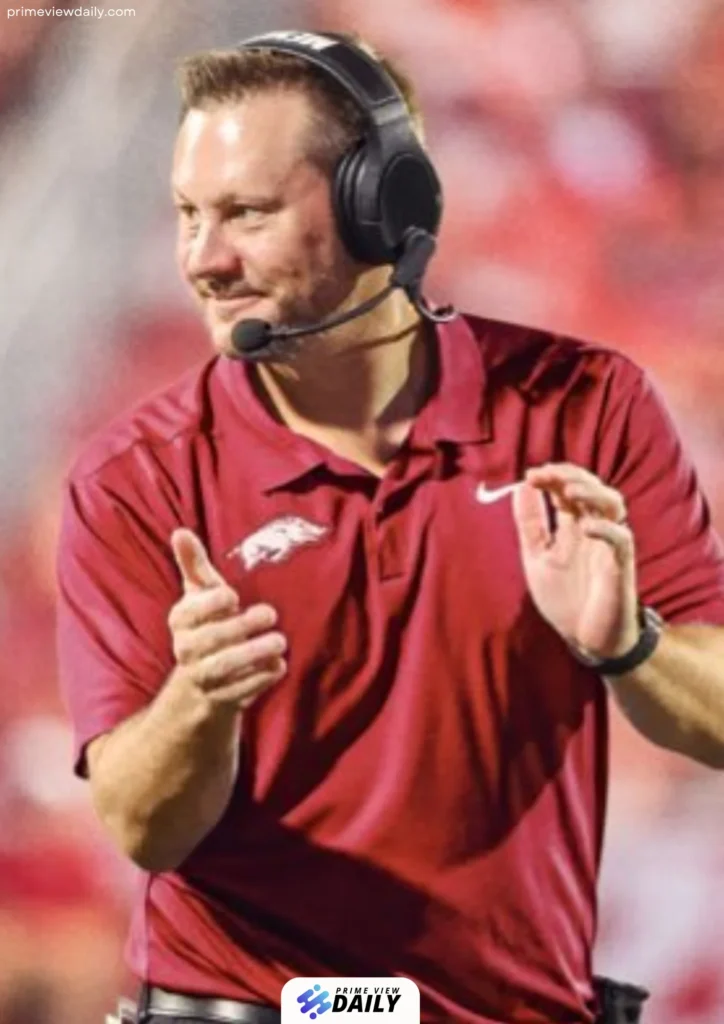
Early Life and a Career-Ending Injury That Changed Everything
Ryan Daniel Silverfield grew up in Jacksonville, Florida, and played defensive line at The Bolles School — one of the most decorated high school football programs in the country. His team reached a number one ranking in the USA Today Super 25 national high school football poll. College scouts took notice.
Then a neck injury ended it all.
After playing on the number one ranked high school team in the nation, Silverfield suffered a career-ending neck injury that finished his playing days for good. He enrolled at Hampden-Sydney College near Richmond, Virginia, with no plan to play football — but coaching turned out to be the better path.
From Injured Prospect to College Coach at 19
During his freshman year at Hampden-Sydney, Silverfield talked his way onto the coaching staff. He worked as an offensive assistant for one year, then coached the defensive line in his sophomore and junior years, and moved to tight ends coach as a senior.
That’s a rare start even by football coaching standards. Most coaches spend years as graduate assistants before getting in front of players. Silverfield directed college defensive linemen at 19. He graduated cum laude from Hampden-Sydney College in 2003 with a degree in economics.
That early start gave him something that would shape his entire career: wide experience across different positions and levels of the game, built up long before most coaches had their first real room.
Building a Résumé the Hard Way
From Savannah to the NFL
After graduation, Silverfield’s path was anything but a straight line to the top. He took the head coaching job at Memorial Day High School in Savannah, Georgia, and went 1–9. After that, he rejoined the college coaching ranks as quarterbacks coach at Jacksonville University, then spent two years as a graduate assistant at UCF, before the Minnesota Vikings brought him on as NFL staff in 2008.
That 1-9 season in Savannah gets glossed over in most profiles, but it matters. Silverfield failed early at the head coaching level, learned from it, and rebuilt his credentials from scratch at the professional level. Very few coaches who end up leading SEC programs have touched the high school, small college, major college, and NFL levels the way he has.
He holds a rare distinction: he is the only coach to have worked with both an NCAA single-season rushing leader (Kevin Smith at UCF) and an NFL single-season rushing leader (Adrian Peterson at Minnesota). That combination points directly to the offensive identity Silverfield has spent two decades building — physical, run-first attacks that can also light up a scoreboard.
The Road to Memphis
Silverfield’s NFL tenure with the Minnesota Vikings ran from 2008 to 2013. He then worked as an offensive consultant at Toledo in 2014 before joining Arizona State as senior offensive analyst in 2015. Later that year, he moved back to the NFL as offensive line coach for the Detroit Lions. When Mike Norvell took the Memphis head coaching job in 2016, he brought Silverfield — whom Norvell had worked with at Arizona State — onto his staff as an assistant.
Coaching Career Timeline
| Year(s) | Role | Institution/Team |
|---|---|---|
| 1999–2000 | High school assistant | The Bolles School, Jacksonville |
| 2000–2003 | Various assistant roles | Hampden-Sydney College |
| 2004 | Head coach | Memorial Day High School, Savannah |
| 2005 | Quarterbacks coach | Jacksonville University |
| 2006–2007 | Graduate assistant | UCF |
| 2008–2013 | Various positions | Minnesota Vikings (NFL) |
| 2014 | Offensive consultant | Toledo |
| 2015 | Senior offensive analyst | Arizona State |
| 2015 | Offensive line coach | Detroit Lions (NFL) |
| 2016–2019 | OL coach / Run game coordinator / Asst. HC | Memphis |
| 2019–2025 | Head coach | Memphis |
| 2026– | Head coach | Arkansas |
The Memphis Years: Six Seasons, Zero Losing Records
A Baptism by Fire in the Cotton Bowl
When Mike Norvell left Memphis for Florida State in December 2019, Silverfield’s moment arrived in the most chaotic way possible. With just three weeks until the Tigers faced Penn State in the 2019 Cotton Bowl Classic, the program named him interim head coach. A week later, on December 13, the “interim” tag came off for good.
Leading a team through a mid-season coaching change into a nationally televised bowl game against a Big Ten opponent — in three weeks — stands as a pressure test most coaches never face. Memphis beat Penn State 29-24 in the Cotton Bowl. It set the tone for everything that followed.
Season-by-Season Results at Memphis
| Season | Record | Notable Achievement |
|---|---|---|
| 2020 | 8-3 | First bowl win (Montgomery Bowl) in program history for a first-year HC |
| 2021 | 6-6 | Seth Henigan earned Freshman All-America honors at QB |
| 2022 | 7-6 | First Memphis HC to win back-to-back bowl games |
| 2023 | 10-2 | Fifth 10-win season in program history; won Liberty Bowl |
| 2024 | 11-2 | Back-to-back 10-win seasons; finished No. 23 AP, No. 24 Coaches Poll |
| 2025 | 8-4 | 12th straight bowl appearance; extended longest active streak among non-Power 4 programs |
Year by Year: What the Numbers Actually Show
In his first full season in 2020, Silverfield guided the Tigers to their first bowl victory since 2014 — a 25-10 win over Florida Atlantic in the Montgomery Bowl — becoming the first head coach in school history to win a bowl game in his first year. The Tennessee Sports Writers Association named him their 2020 Coach of the Year.
The 2023 season pushed Silverfield into another historical category. Leading Memphis to a 10-2 record, he captured TSWA Coach of the Year honors for a second time, making him the first Memphis coach ever to win the award twice. The Tigers won their fifth 10-win season in program history and beat Iowa State 36-26 in the AutoZone Liberty Bowl — his fourth bowl victory as head coach.
The 2024 campaign stands as arguably the program’s finest in the modern era. Memphis went 11-2 and knocked off West Virginia in the Frisco Bowl, finishing No. 23 in the Coaches Poll and No. 24 in the AP Poll — the first top-25 finish for the program since 2019. The Tigers cracked the College Football Playoff Top 25 at No. 25 in December after snapping Tulane’s 17-game conference winning streak.
One number captures the full picture of his Memphis tenure: six bowl games in six seasons. His final Tigers team pushed the program’s streak to 12 straight bowl appearances — the longest active streak among non-Power 4 programs in the nation.
The One Criticism That Followed Him Out of Memphis
Silverfield’s Memphis record wasn’t without fair criticism. Despite consistent winning overall, he finished 12-20 against teams above .500 and never reached the AAC Championship Game in any of his six seasons.
That record against quality opponents matters most in the SEC, where nearly every opponent qualifies. Answering that question in Fayetteville is the central challenge of his career.
What Kind of Coach Is Ryan Silverfield?
He Builds Through the Offensive Line
Every part of Silverfield’s coaching identity traces back to his years as an offensive line coach. His teams emphasize the run game, but they also score in bunches — Memphis averaged 34.4 points per game across his tenure and led the American Conference in scoring offense twice, in 2023 and 2024.
Silverfield makes a direct argument for why offensive line coaches make better head coaches than coaches who work with smaller position groups: “As an offensive line coach, you’re dealing with about 20 guys in your room every time,” he said. “And no knock on a quarterback coach, a tight ends coach, but if you’re dealing with four guys at a time and that’s all you’re dealing with, there’s certain things that you haven’t seen.”
All six of Silverfield’s Memphis teams averaged 30+ points per game. That’s the floor, not the ceiling.
Fundamentals Over Schemes
Despite running high-powered offenses, Silverfield holds a deliberately anti-scheme philosophy. “I tell our staff all the time, we’ve got enough scheme to last us a lifetime,” he said. “None of that crap matters right now. I always want to go back to the basic fundamentals.”
The reasoning is practical. In the transfer portal era, rosters come together from dozens of programs with different vocabularies and habits. The only common language players share on day one is whether they can block, tackle, pursue, and secure the ball. A team can install a new scheme in a week; building fundamentals takes a full offseason.
Accountability as a Non-Negotiable
Silverfield builds player relationships on honest accountability, not friendship. “I’ve had players that I’ve coached everywhere that say, ‘There’s times I don’t like you at all, but I love you and I respect you,'” he said. “I’m not here to be my players’ best friend. I’m here to tell them the truth and hold them accountable.”
Ball Security as a Culture Marker
Over four recent seasons at Memphis, the Tigers ranked among the nation’s most careful ball-handling teams: No. 16 in 2022 at +6 in turnover margin, No. 17 in 2023 at +5, No. 2 in a later season at +18, and No. 15 in 2025 at +7.
A program that consistently wins the turnover battle wins more games than its talent alone would suggest. The Arkansas team Silverfield inherited went in the opposite direction, ranking last in the SEC in turnover margin in 2025. Closing that gap ranks as arguably his most important task in year one.
Ryan Silverfield at Arkansas: The SEC Test
Why He Chose Arkansas
Silverfield became the 35th head football coach at the University of Arkansas on November 30, 2025. Plenty of people doubted the move. “They said ‘You can’t win there. Should’ve taken UCLA, Auburn,'” Silverfield told the Little Rock Rotary Club. “I said no, I like that we can set the standard at Arkansas.”
He walked into a program that had gone 2-10 in 2025 under Sam Pittman, who lost his job after six games, with interim coach Bobby Petrino going 0-7 to close out the season. Arkansas went 0-6 in one-score games that year. The talent gap was real, but the habits and decision-making gap may have been larger.
The Culture Reset — In Specific, Concrete Terms
Silverfield’s culture overhaul at Arkansas started on the first walk through the building — literally.
“From the minute I got here, literally, my first steps down that hallway, my very first comment was, ‘This lighting sucks. This is a dungeon. This is a loser mentality,'” he said. “Getting that out of a program and getting these guys to understand, ‘No, no, no. We’re not going to operate this way, right?'”
He launched “War on the Hill” — an offseason conditioning program run as a team-wide competition. Six captains selected their teams in a snake-draft. Assistant coaches each joined a team. Groups earned points through conditioning drills but lost them for being late to class, getting parking tickets, or having messy lockers — one team dropped 40 points over a disorganized locker. Defensive end Charlie Collins explained the earbud rule Silverfield put in place: “Coach Silverfield says you can have one in but not two, because you never know when a coach might say something.”
Those specifics matter. Accountability structures only hold up when they reach the details no one expects — the locker, the parking spot, the earbud. Players coming from loosely run programs notice that difference fast.
The Roster He’s Working With
The 2026 Arkansas roster includes 13 high school commits and 42 transfers, seven of them from Memphis. Quarterback competition entering fall camp sits between redshirt sophomore KJ Jackson and Memphis transfer AJ Hill, with Silverfield confirming the job will stay open through August.
Offensive coordinator Tim Cramsey followed Silverfield from Memphis, and defensive coordinator Ron Roberts rounds out the new staff’s top tier. The defensive line room hit early turbulence when position coach Marion Hobby left for the Indianapolis Colts after just two months on the job. Silverfield had prepared for exactly that scenario by hiring two coaches at both the offensive and defensive line positions.
The Bigger Picture: What Makes Silverfield Different
There are a few things about Silverfield’s path that genuinely separate him from the standard Group of Five coach making the jump to a Power 4 program.
He Started Coaching Earlier Than Almost Anyone at His Level
Most P4 head coaches worked as graduate assistants in their mid-20s. Silverfield directed college players at 19 and became a high school head coach at 23. That’s an extra half-decade of player-facing experience before he ever reached a major college program.
His NFL Years Go Beyond a Résumé Line
Seven years with the Vikings and Lions gave him direct knowledge of how professional organizations build culture, manage large rosters, and assess talent at scale. Purely college-track coaches never develop that frame of reference. Those lessons show up in programs like “War on the Hill” and in how he thinks about accountability structures across an entire team.
Loyalty Defined His Memphis Tenure
From the moment he arrived there, Silverfield fielded interest from the Big 12, Big Ten, SEC, and NFL. He stayed anyway, believing in what the program could become. That patience is rare in a profession built on constant movement — and it meant he took over a program he understood from the inside out.
Turnover Margin Is a Culture Signal, Not Just a Stat
In a sport where special teams and turnovers swing roughly a third of close games, Silverfield built one of the most turnover-positive programs in the country at Memphis. That’s not a scheme achievement. It reflects daily accountability habits across an entire program. Arkansas ranked 125th out of 134 FBS programs in turnover margin in 2025. The distance Silverfield needs to cover is large, but it’s the exact kind of gap he has built his career closing.
Personal Life
Ryan Silverfield is married to Katie VanLandingham, a lobbyist and Memphis native. The couple has twin girls named Adeline and Cecilia. Silverfield keeps his family life largely out of the public eye, and that approach has not changed since his move to Fayetteville.
FAQs About Ryan Silverfield
Career, Background, and Coaching Philosophy
What is Ryan Silverfield’s career coaching record? Silverfield finished his Memphis tenure with a 50-25 record, making him one of the winningest coaches in program history. He enters the 2026 season as Arkansas head coach carrying that same career mark.
Why did Ryan Silverfield leave Memphis for Arkansas? Arkansas Athletics Director Hunter Yurachek said the program was making major financial investments in football and believed Silverfield’s proven ability to win over a sustained stretch made him the right hire. Silverfield said he chose Arkansas because he believed he could build a standard there, turning down interest from other available programs in the process.
What is Ryan Silverfield’s coaching philosophy? Silverfield’s approach rests on three things: physical, run-game-oriented offense; fundamentals over scheme complexity; and accountability-driven culture that reaches into the small details of daily program life. His offenses have averaged over 30 points per game in each of his six seasons as a head coach.
Did Ryan Silverfield play college football? No. A neck injury ended his playing days at The Bolles School in Jacksonville, Florida. He never played a college snap, enrolling at Hampden-Sydney College and immediately stepping into coaching instead.
Arkansas, the SEC, and What’s Next
What is “War on the Hill” at Arkansas? “War on the Hill” is Silverfield’s offseason team-building competition. Six captains draft teams in a snake-style format, and those groups compete through conditioning drills while earning and losing points based on both athletic performance and off-field behavior — including class attendance, parking, and locker organization. Silverfield ran similar programs at Memphis to build cohesion from scratch.
When does Arkansas open the 2026 season under Silverfield? The Razorbacks host North Alabama on September 5, 2026 to open the Ryan Silverfield era.
What was Ryan Silverfield’s NFL experience? Silverfield spent seven years in the NFL — with the Minnesota Vikings from 2008 to 2013 in various roles, and with the Detroit Lions in 2015 as offensive line coach. That professional background is uncommon among Group of Five head coaches and shapes how he thinks about building and managing a large program.
What are the fair criticisms of Silverfield as a head coach? The main critique from his Memphis years is a losing record against teams above .500 and no AAC Championship Game appearances across six seasons. In the SEC, where every opponent plays at a winning level, that track record faces its stiffest test yet.
Conclusion
Ryan Silverfield spent more than two decades earning the right to coach at college football’s highest level. His path — from a 19-year-old assistant at a Division III school to the head coach of an SEC program — is long, varied, and hard to replicate. He failed in public early (1-9 in Savannah), rebuilt quietly for years (Minnesota, Detroit), and then won consistently when given his shot (50-25 at Memphis, six bowl games, two top-25 finishes).
The Arkansas job is harder than anything he has taken on before. The SEC gap is real, the roster needs serious work, and the fanbase has waited years for a program to get back on its feet. What Silverfield brings to that challenge is a specific, tested system built on physical football, turnover discipline, and accountability structures that reach into the smallest corners of a program’s daily life.
The 2026 season opens September 5 against North Alabama — the first real data point on whether that system translates to the SEC. What is already clear is that Silverfield approaches this program with the same methodical focus he has carried to every stop on a coaching career that began on a bench in rural Virginia more than twenty-five years ago.
Read about tyler-herro-injury/