


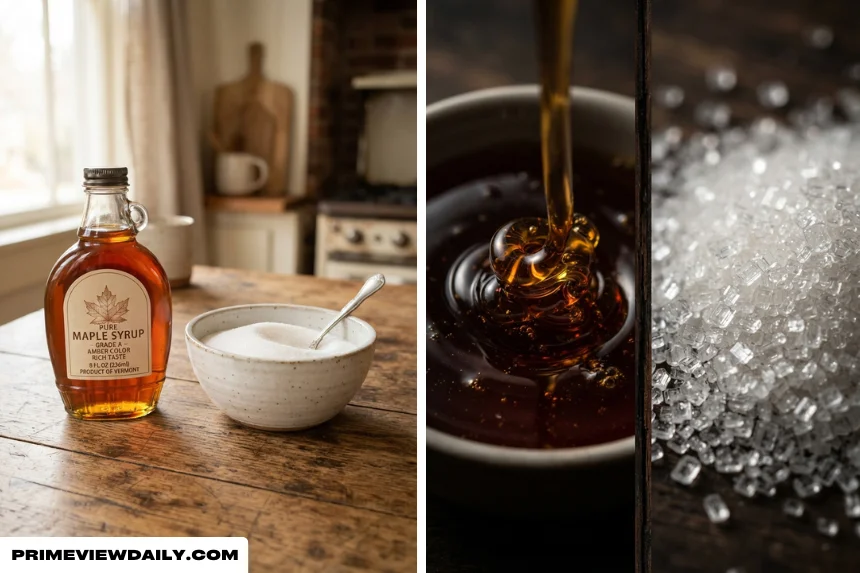
Maple syrup is slightly more nutritious than white sugar, but that does not make it a health food. Pure maple syrup contains small amounts of minerals, vitamins and plant compounds that ordinary granulated sugar does not provide. It may also have a somewhat gentler effect on blood glucose when the same amount of refined sugar is replaced with maple syrup.
The difference, however, is easy to exaggerate. Both sweeteners contain substantial amounts of sugar, provide roughly similar calories by the tablespoon and count toward your daily intake of added or free sugars. Neither contains fiber, protein or enough essential nutrients to justify consuming more of it.
For most people, the better choice depends on portion size, taste, cost and how the sweetener is being used. Choosing pure maple syrup may offer a modest advantage, but reducing the total amount of sweetener usually matters more.
Is Maple Syrup Healthier Than Sugar?
Pure maple syrup has a slightly better nutritional profile than white sugar. It contains manganese, riboflavin and small amounts of other minerals, along with naturally occurring plant compounds. White sugar provides energy but virtually no vitamins, minerals or antioxidants.
That advantage is limited because maple syrup is still primarily sugar. The U.S. Food and Drug Administration classifies both table sugar and single-ingredient syrups as sources of added sugar.
A practical way to think about the difference is:
- Maple syrup is the more nutrient-rich sweetener.
- Neither option is particularly nutrient-dense.
- The amount you consume matters more than the name on the bottle
Maple Syrup vs. Sugar: Nutrition Comparison
Approximate values for one level tablespoon are shown below. Exact amounts can vary slightly by product and measuring method.
| Nutrient | Pure maple syrup | White granulated sugar |
|---|---|---|
| Calories | About 52 | About 49 |
| Total carbohydrate | About 13.4 g | About 12.6 g |
| Sugar | About 12 g | About 12.6 g |
| Fiber | 0 g | 0 g |
| Protein | Negligible | 0 g |
| Notable micronutrients | Manganese and riboflavin | Negligible |
Pure maple syrup contains about 52 calories and 13 grams of carbohydrate per tablespoon. It also supplies measurable manganese and riboflavin, although most other nutrients are present only in small quantities.
The calorie difference between the two is therefore not meaningful in a typical spoon-for-spoon serving. Maple syrup contains more water than granulated sugar, which makes it less calorie-dense by weight, but a tablespoon of syrup and a tablespoon of sugar still provide similar amounts of energy.
What Is Pure Maple Syrup Made From?
Pure maple syrup is produced by collecting sap from maple trees and boiling away much of its water. The concentrated syrup is primarily composed of sucrose, the same type of sugar found in ordinary table sugar, with smaller quantities of glucose, fructose and other carbohydrates.
It also contains organic acids, minerals and polyphenols formed naturally in the sap or during processing. These compounds help create maple syrup’s distinctive color and flavor.
The word “natural” does not mean sugar-free or low-sugar. Maple syrup is less refined than white sugar, but your body still breaks down much of its carbohydrate into glucose and fructose.

Pure maple syrup is not the same as pancake syrup
Check the ingredient list when buying syrup. A bottle labelled 100% pure maple syrup should contain maple syrup as its only ingredient.
Products described as pancake syrup, breakfast syrup or maple-flavored syrup may instead contain corn syrup, glucose syrup, added flavors, colors and preservatives. They should not be assumed to have the same composition as pure maple syrup.
Does Maple Syrup Raise Blood Sugar?
Yes. Maple syrup contains digestible carbohydrate and can raise blood glucose.
It is sometimes described as having a lower glycemic index than white sugar. That suggests it may produce a somewhat slower glucose response under controlled testing conditions. However, the difference does not turn maple syrup into a low-carbohydrate or diabetes-neutral food. Cleveland Clinic notes that maple syrup contains no fiber and that consuming too much may still cause fluctuations in blood glucose and insulin.
Your actual glucose response will also depend on:
- The amount of syrup used.
- The rest of the meal.
- Whether the food contains fiber, fat or protein.
- Your insulin sensitivity.
- Any diabetes medication you take.
- Your recent activity, sleep and stress levels.
Adding two tablespoons of maple syrup to pancakes is very different from using half a teaspoon in a bowl of unsweetened oatmeal with nuts.
Is maple syrup better than sugar for diabetes?
Maple syrup may be a slightly preferable replacement for refined sugar, but it still needs to be counted as carbohydrate. The American Diabetes Association includes syrups among added sugars and recommends reading labels and monitoring total carbohydrate intake when managing blood glucose.
People with diabetes should not begin using larger quantities of maple syrup because it is marketed as natural. Individual glucose responses can vary, so portion size and personal monitoring remain important.
This information is educational and is not a substitute for guidance from a doctor or registered dietitian, particularly if you use insulin or medication that can cause low blood glucose.
What Does the Research Say?
Most early research into maple syrup’s possible benefits involved laboratory experiments or animals. These studies identified antioxidant compounds and suggested that maple syrup might affect carbohydrate digestion, inflammation or gut bacteria differently from refined sucrose. Such findings are useful for guiding future research but cannot by themselves prove a health benefit in humans.
A randomized controlled crossover trial published in The Journal of Nutrition in 2024 studied 42 adults with mild metabolic risk factors. Participants replaced refined sugar with maple syrup for eight weeks, then switched treatments after a washout period. The maple syrup phase was associated with improvements in some measurements involving glucose response, abdominal fat and systolic blood pressure compared with the refined-sugar syrup.
The trial provides more useful evidence than laboratory or animal research, but it does not settle the question. Important limitations include:
- Only 42 people participated.
- Each treatment period lasted eight weeks.
- The participants had specific metabolic characteristics.
- Some reported outcomes were exploratory.
- The study was funded partly by Québec maple syrup producers and a provincial agriculture department.
The results suggest that maple syrup could be less metabolically unfavorable than an equivalent quantity of refined sugar. They do not show that adding maple syrup to an otherwise unchanged diet prevents diabetes, produces meaningful weight loss or improves long-term health.
A broader scientific review published in 2025 concluded that research remains too limited to state confidently that maple syrup is a healthier sweetener overall.
Are the Minerals and Antioxidants Meaningful?
Maple syrup’s manganese and riboflavin content is real. It also contains polyphenols and other bioactive compounds not present in refined white sugar.
However, it is not an efficient way to obtain most nutrients. To consume more of these compounds, you would also have to consume more sugar and calories. Vegetables, fruit, nuts, beans and whole grains provide a wider range of beneficial nutrients, often with fiber and substantially less added sugar.
Maple syrup’s micronutrients are therefore best viewed as a small bonus when you already intend to use a sweetener—not as a reason to add syrup to your diet.

Is Maple Syrup Better for Weight Loss?
Replacing sugar with the same number of tablespoons of maple syrup is unlikely to create a meaningful calorie reduction. One tablespoon of each contains close to 50 calories.
Maple syrup could indirectly help in limited situations. Its strong flavor may allow some people to feel satisfied with a smaller quantity. That benefit depends on actually using less. Pouring freely because the syrup appears healthier would cancel it out.
For weight management, more effective strategies include:
- Gradually reducing the sweetness of drinks and meals.
- Measuring syrup instead of pouring directly from the bottle.
- Using fruit, cinnamon or vanilla to add flavor.
- Choosing unsweetened products and adding a controlled amount yourself.
- Pairing carbohydrates with foods containing fiber or protein.
Is Maple Syrup Considered Added Sugar?
Yes. When maple syrup is poured into coffee, oatmeal, baked goods, sauces or other foods, its sugar counts toward added or free sugar intake.
The FDA includes table sugar, honey and syrups within its definition of added sugars. Its Daily Value is 50 grams of added sugar for a 2,000-calorie diet, although individual needs vary.
The World Health Organization uses the term free sugars, which includes sugars added by a manufacturer, cook or consumer as well as sugars naturally present in syrups and honey. WHO recommends keeping free sugars below 10% of total energy intake and suggests reducing them below 5% for additional benefits.The FDA includes table sugar, honey and syrups within its definition of added sugars on the Nutrition Facts label.
These limits apply to maple syrup even when the bottle contains nothing artificial.
When Maple Syrup May Be the Better Choice
Pure maple syrup may be preferable when:
- You enjoy its flavor and can use a small portion.
- You want a sweetener with some manganese and riboflavin.
- It replaces, rather than supplements, another added sugar.
- Its liquid form works well in oatmeal, yogurt, dressings or sauces.
- You are buying 100% pure syrup rather than maple-flavored corn syrup.
White sugar may be more practical when:
- A recipe relies on its dry texture or structure.
- You do not enjoy maple flavor.
- Maple syrup is significantly more expensive.
- Using syrup would encourage you to consume a larger portion.
- You need predictable results in a delicate baked recipe.
The healthiest decision may also be to use less of whichever sweetener suits the food.
Can You Replace Sugar With Maple Syrup in Baking?
Maple syrup can replace sugar in many recipes, but it is not always a straightforward one-to-one swap. Sugar is dry, while maple syrup adds both sugar and liquid.
A substitution may change:
- Batter moisture.
- Browning.
- Texture.
- Spread.
- Cooking time.
- The finished maple flavor.
It works most easily in forgiving recipes such as muffins, quick breads, marinades, sauces and baked oatmeal. Cakes, cookies, frostings, candies and meringues may depend more heavily on the physical properties of granulated sugar.
For reliable results, use a recipe developed with maple syrup or make a small test batch before changing a special-occasion recipe.
How to Use Maple Syrup More Mindfully
A measured portion can provide sweetness and flavor without dominating the meal.
Try these practical approaches:
- Measure it with a teaspoon. A small drizzle is easy to underestimate when poured directly from the bottle.
- Combine it with unsweetened foods. Add a little to plain oatmeal or yogurt instead of buying a heavily sweetened version.
- Use flavor to your advantage. Cinnamon, nutmeg, vanilla, berries and toasted nuts can make a smaller amount of syrup feel more satisfying.
- Avoid stacking sweeteners. A meal containing sweetened yogurt, granola, syrup and a sweetened drink can add up quickly.
- Check the label. Look for “100% pure maple syrup” and review the serving size.
Frequently Asked Questions
Is maple syrup more natural than white sugar?
Maple syrup is produced by concentrating maple sap, while white sugar is extracted and refined from sugar cane or sugar beets. Maple syrup is generally less refined, but both are concentrated sweeteners and both count as added or free sugar.
Does maple syrup have less sugar than white sugar?
A tablespoon of maple syrup contains slightly less sugar than a tablespoon of granulated sugar, but the difference is small. Both servings contain roughly 12 grams of sugar.
Is maple syrup anti-inflammatory?
Maple syrup contains polyphenols that have shown antioxidant or anti-inflammatory activity in laboratory research. There is not enough human evidence to treat maple syrup as an anti-inflammatory food or therapy.
Is maple syrup better than brown sugar?
Maple syrup contains more manganese, riboflavin and plant compounds than brown sugar. Both remain concentrated sources of added sugar, so any nutritional advantage is modest.
Is honey or maple syrup better than sugar?
Honey and maple syrup contain small amounts of compounds absent from refined sugar, but both are still free sugars. The better option is usually the one you enjoy in the smallest useful quantity.
Can children have maple syrup?
Children older than 12 months can generally consume maple syrup as a food, but it should remain an occasional source of added sugar. Babies under 12 months must not be given honey because of the risk of infant botulism; that restriction is specific to honey, not pure maple syrup.
Conclusion
Pure maple syrup is marginally better than white sugar from a nutritional perspective. It provides a few micronutrients and plant compounds, and early human research suggests it may have modest advantages when it directly replaces refined sugar.
The difference is not large enough to make portion size irrelevant. Maple syrup still raises blood glucose, contains no fiber and counts as added or free sugar. Choose it for its flavor and use it in measured amounts, rather than treating it as an unlimited healthy alternative.
Discover more on our website about Can I Eat Strawberries With GERD?