

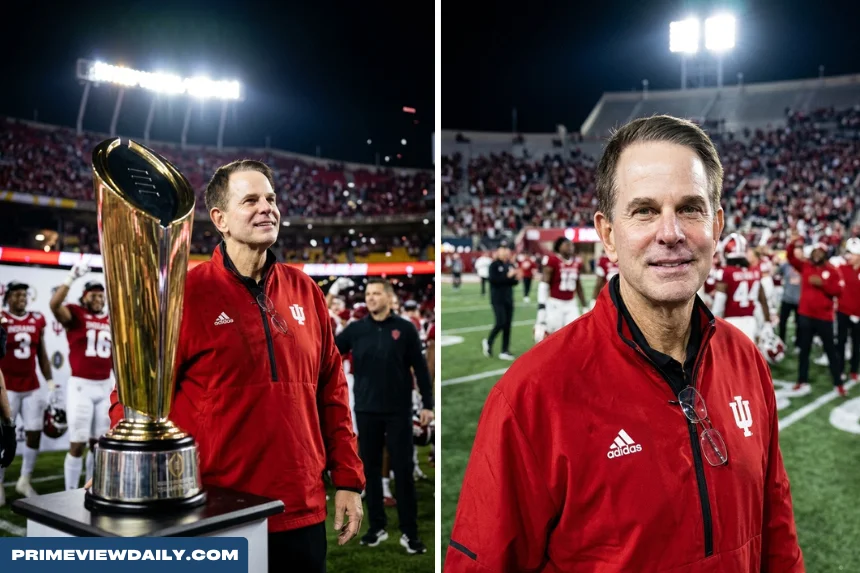
The current Curt Cignetti contract is worth $105.6 million across eight contract years, averages $13.2 million per year, and runs through November 30, 2033. Indiana revised his compensation in February 2026 after the Hoosiers reached the College Football Playoff semifinal and won the national championship. However, the revision did not add years to the eight-year term announced in October 2025.
That distinction explains the conflicting numbers online. The October agreement averaged $11.6 million and was worth roughly $92.8 million. The later market review raised the economics to $105.6 million while leaving the end date intact.
Curt Cignetti Contract: Quick Answer
| Contract item | Current term |
|---|---|
| School | Indiana University |
| Position | Head football coach |
| Contract years | Eight |
| Approximate total before performance incentives | $105.6 million |
| Average annual compensation | $13.2 million |
| First revised contract year | $13.025 million |
| Final contract year | $13.375 million |
| Annual base salary | $500,000 |
| Annual retention payment | $1 million |
| End date | November 30, 2033 |
| Largest resignation buyout | $15 million |
| Without-cause protection | 100% of remaining compensation, subject to offsets |
Key Facts About the Deal
The Curt Cignetti contract combines guaranteed scheduled compensation with conditional incentives and program-level protections. Its most important terms are:
- February 2026 brought a raise, not a new extension.
- The revised scheduled compensation totals $105.6 million before performance bonuses.
- Outside, marketing, and promotional income accounts for most of the annual pay.
- A $1 million retention payment rewards Cignetti for remaining at Indiana through November 30 each year.
- CFP incentive payments are based on the highest finish and are not cumulative.
- The resignation buyout falls from $15 million to zero over the term.
- Indiana must pay the remaining contract value if it terminates him without cause, although later coaching income can offset that obligation.
- Market-review provisions also protect investment in staff and program resources.
What Is the Current Curt Cignetti Contract Worth?
Public-record reporting by the Indiana Daily Student places the revised deal at $105.6 million over eight contract years. That produces an average of $13.2 million before performance incentives. Cignetti signed the compensation memorandum on February 4, 2026, and news of the revision emerged later that month.
The phrase “salary” can cause confusion because only $500,000 of the annual package carries the base-salary label. The rest primarily comes through outside, marketing, and promotional compensation plus a retention payment. Therefore, $13.2 million is best described as average annual compensation rather than base salary.
The new figure placed Cignetti at or near the top of the publicly known college-football coaching market in early 2026. Yet rankings vary with the source, date, bonuses, private-school disclosure, and whether a comparison uses annual average or a single year. Front Office Sports described the $13.2 million average as the highest known figure when the revision became public.
Curt Cignetti Contract Year-by-Year Compensation
The revised schedule rises by $50,000 per contract year. These figures come before performance incentives:
| Contract year | Scheduled compensation |
| Jan. 1–Nov. 30, 2026 | $13,025,000 |
| Dec. 1, 2026–Nov. 30, 2027 | $13,075,000 |
| Dec. 1, 2027–Nov. 30, 2028 | $13,125,000 |
| Dec. 1, 2028–Nov. 30, 2029 | $13,175,000 |
| Dec. 1, 2029–Nov. 30, 2030 | $13,225,000 |
| Dec. 1, 2030–Nov. 30, 2031 | $13,275,000 |
| Dec. 1, 2031–Nov. 30, 2032 | $13,325,000 |
| Dec. 1, 2032–Nov. 30, 2033 | $13,375,000 |
Together, the eight amounts equal $105.6 million. The first listed period begins January 1 and runs for 11 months, while later years begin December 1. Consequently, readers should use the published schedule rather than assuming eight identical $13.2 million payments.
The schedule also resolves another apparent contradiction. A separate public-record report described first-year compensation as $13.025 million, which is below the $13.2 million average. Both figures are correct because later scheduled years rise gradually.
How Is the Compensation Structured?
The agreement uses several payment categories. First, Cignetti receives a $500,000 annual base salary. Second, he receives a $1 million retention payment on November 30, provided the relevant terms are satisfied.
Most of the remaining amount comes from outside, marketing, and promotional income. This category generally compensates a coach for media, endorsement, appearance, and promotional obligations owed under the university agreement. It does not mean that an unrelated company pays the whole amount.
Performance incentives sit above the scheduled compensation. In addition, the agreement includes benefits such as a courtesy-car allowance, adidas merchandise, event tickets, golf access, parking, and meals at the athletic dining facility. Those benefits matter to the complete package, but they do not materially change the $105.6 million headline.
Why Did the Number Change From $11.6M to $13.2M?
Indiana announced an eight-year agreement in October 2025 with average annual compensation of approximately $11.6 million. The Associated Press valued that version at about $92.8 million and reported the November 30, 2033 end date.
However, the October memorandum contained a market-protection clause. If Indiana reached the CFP semifinal, the university and coach had to conduct a good-faith compensation review within 120 days. The target was pay no lower than third among active FBS head coaches eligible for the playoff.
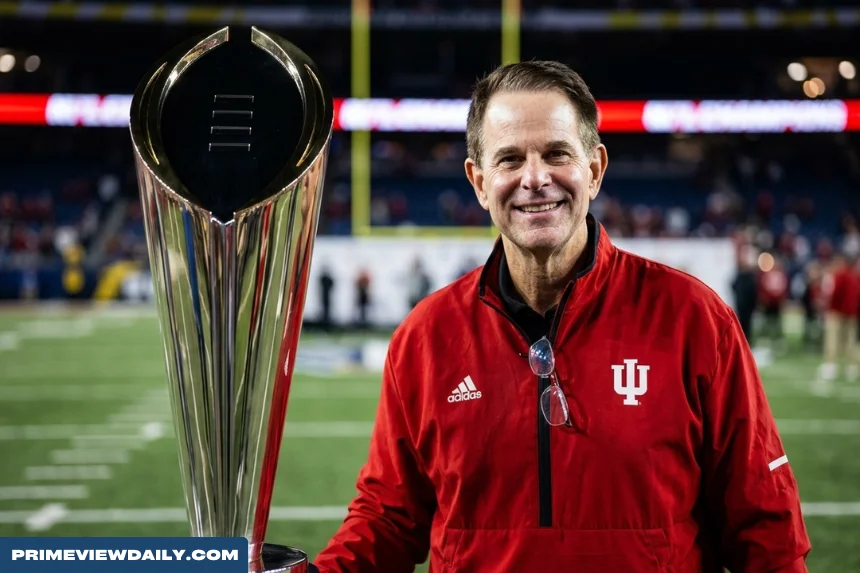
Indiana secured a semifinal place by beating Alabama in the Rose Bowl quarterfinal. It then beat Oregon in the semifinal and Miami in the national championship game. The official College Football Playoff recap records Indiana’s 16-0 finish and first national title.
As a result, the review clause produced a $1.6 million increase in average annual compensation. CBS Sports reported that the pay moved from $11.6 million to $13.2 million while the term continued through 2033. In short, the $92.8 million story describes the October version, while $105.6 million describes the current revised schedule.

What Did the Good-Faith Market Review Do?
The clause tied pay protection to elite performance. Once the team reached the semifinal, both sides had to review the coaching market and negotiate. If Indiana did not offer compensation placing Cignetti among the top three, his contractual resignation buyout would be void.
This structure gave each side something valuable. Cignetti received a mechanism that kept his compensation aligned with successful peers. Meanwhile, Indiana did not have to grant the additional raise unless the program reached one of college football’s final four positions.
The clause is more than a vague promise to discuss salary. It included a deadline, a market-ranking goal, and a consequence for failure to agree. A Marquette University sports-law comparison highlights this combination of long duration, market review, and program investment as an important feature of the agreement.
Within the Curt Cignetti contract, that consequence gave the market review practical force: Indiana risked losing its resignation protection if it did not keep compensation competitive.
Which Performance Bonuses Can Cignetti Earn?
The February revision kept the October incentive structure. A sixth Big Ten win produces a $150,000 bonus, while five wins produces $100,000. Because the thresholds cover the same achievement category, the higher six-win amount replaces rather than stacks on the lower figure.
The playoff bonuses are also noncumulative. Cignetti receives the amount tied to Indiana’s highest CFP finish:
| CFP result | Bonus |
| First-round appearance | $500,000 |
| Quarterfinal appearance | $600,000 |
| Semifinal appearance | $700,000 |
| National runner-up | $1 million |
| National champion | $2 million |
Therefore, winning the title earns $2 million from the CFP ladder, not the sum of all five stages. The contract also offers $50,000 for Big Ten Coach of the Year and $100,000 for at least one qualifying national Coach of the Year award.
The Indiana Daily Student’s report on the October memorandum also identified bonuses for conference standing and non-CFP bowl participation. However, the playoff ladder became the most relevant category during Indiana’s championship season.
What Is the Curt Cignetti Contract Buyout?
A resignation buyout is money the coach owes the university when leaving under specified circumstances. Cignetti’s schedule applies if he resigns to accept a coaching position in college football or the NFL. It falls as the contract approaches expiration:
| Departure window | Buyout owed to Indiana |
| Dec. 1, 2025–Nov. 30, 2026 | $15 million |
| Dec. 1, 2026–Nov. 30, 2027 | $12 million |
| Dec. 1, 2027–Nov. 30, 2028 | $9 million |
| Dec. 1, 2028–Nov. 30, 2029 | $6 million |
| Dec. 1, 2029–Nov. 30, 2030 | $4 million |
| Dec. 1, 2030–Nov. 30, 2031 | $2 million |
| Dec. 1, 2031–Nov. 30, 2032 | $1 million |
| Dec. 1, 2032–Nov. 30, 2033 | $0 |
The schedule protects Indiana most strongly near the beginning, when the university has made its largest forward commitment. Later, the amount declines because fewer contract years remain.
Two qualifications matter. First, the buyout falls by 50% if either the specified university president or athletic director is no longer in that position when Cignetti leaves. Second, the market-review clause could eliminate the buyout if Indiana failed to reach the required top-three compensation after a triggered negotiation.
What Happens If Indiana Fires Cignetti?
The reverse buyout is much larger. If Indiana terminates Cignetti without cause, the university owes 100% of the compensation remaining on the agreement, generally through monthly payments. “Without cause” means a dismissal that does not rely on one of the contract’s defined misconduct or breach grounds.
However, the obligation includes an offset. If Cignetti later accepts another college or NFL head-coaching or assistant-coaching job during the original term, compensation from that position can reduce Indiana’s payment. The agreement reportedly removed an affirmative duty to seek comparable work, so an offset and a duty to mitigate should not be treated as identical concepts.
This protection makes an early dismissal potentially expensive. For example, a termination with many years remaining could create an obligation approaching the unpaid scheduled value before any offset. Therefore, the contract strongly encourages long-term alignment on both sides.

How Does the Contract Protect Staff and Program Investment?
Head-coach compensation is only one part of building a roster. The agreement also commits Indiana to make reasonable efforts to maintain a competitive pool for assistant coaches, strength staff, operations, and support personnel.
A review can occur if that staff pool drops below fifth in the Big Ten or tenth nationally. Rather than locking one dollar amount into an eight-year document, this mechanism responds to a changing market. Cignetti’s prior agreement had identified an $11 million staff pool, which showed the scale of Indiana’s commitment.
The deal also calls for regular discussions about resources for player retention and acquisition. That language reflects the modern environment of revenue sharing and transfer movement. Consequently, Cignetti negotiated not only personal pay but also processes intended to keep the overall football operation competitive.
How Has Curt Cignetti’s Indiana Pay Changed?
Cignetti’s compensation rose unusually quickly because Indiana’s results changed unusually quickly. Sports Illustrated summarized four agreements or revisions since his hiring:
| Date | Reported structure |
| November 2023 | Six years, $4.5 million average per year |
| November 2024 | Eight years, $8 million average per year |
| October 2025 | Eight years, $11.6 million average per year |
| February 2026 | No added years, $13.2 million average per year |
The first three steps responded to hiring, an immediate breakthrough, and Indiana’s emergence as a national contender. The fourth resulted from a negotiated clause after the team reached the semifinal and won the title.
For general biographical context beyond the contract, Cignetti’s Wikipedia profile summarizes his head-coaching path through IUP, Elon, James Madison, and Indiana. Still, contract terms should come from the memorandum or reporting based on that document.
Why Was Indiana Willing to Commit $105.6M?
Indiana priced continuity against the risk of losing the coach who transformed its football results. Cignetti led the program to the playoff in his first season, then to a 16-0 record, an outright Big Ten title, and the national championship in his second. Those achievements increased both his market value and the revenue opportunities around Indiana football.
The contract also signals a broader institutional choice. Indiana historically carried a basketball-first reputation, but the university chose to fund football leadership, staff retention, and roster support at a national level. The agreement therefore acts as both compensation and competitive strategy.
Of course, a long guaranteed contract transfers risk to the university. Results can decline, leadership can change, and college-sports economics can shift before 2033. However, the declining resignation buyout, market reviews, offsets, and performance triggers distribute some of that risk rather than relying on one fixed salary promise.
Frequently Asked Questions
1. What is Curt Cignetti’s current contract?
The current agreement pays approximately $105.6 million across eight contract years, averaging $13.2 million annually before performance incentives. It runs through November 30, 2033.
2. How much is the Curt Cignetti contract worth in total?
The revised scheduled compensation totals $105.6 million. Performance bonuses and smaller benefits can raise the overall value.
3. When does Curt Cignetti’s contract end?
It ends November 30, 2033. The February 2026 revision increased compensation but did not extend that date.
4. How much does Curt Cignetti make each year?
Scheduled compensation begins at $13.025 million for the first revised period and rises by $50,000 per contract year to $13.375 million. The eight-year average is $13.2 million.
5. What is Curt Cignetti’s base salary?
His labeled base salary is $500,000 annually. However, outside, marketing, and promotional income plus a $1 million retention payment make total annual compensation much higher.
6. What bonuses can Curt Cignetti earn?
He can earn bonuses for conference wins, conference standing, CFP participation, a national championship, and coaching awards. The CFP ladder ranges from $500,000 for a first-round appearance to $2 million for a national title, with only the highest achieved CFP amount applying.
7. What is Curt Cignetti’s buyout if he leaves Indiana?
The resignation buyout starts at $15 million in the first window, then falls to $12 million, $9 million, $6 million, $4 million, $2 million, $1 million, and finally zero. Leadership changes can cut the applicable amount in half.
8. What happens if Indiana fires Curt Cignetti?
If Indiana fires him without cause, it owes 100% of the remaining contract compensation. Income from a later college or NFL coaching position can offset part of that obligation.
9. What was the good-faith market review?
Reaching the CFP semifinal triggered a negotiation intended to keep Cignetti among the three highest-paid active FBS coaches. If the sides had failed to reach that level, his resignation buyout could have disappeared.
10. Why did Indiana give Curt Cignetti another raise?
Cignetti met the performance condition in his October agreement and then led Indiana to its first national championship. The raise fulfilled the review clause while helping Indiana retain a coach whose market value had increased sharply.
Conclusion
The current Curt Cignetti contract is an eight-year, $105.6 million commitment through November 30, 2033. Its $13.2 million average combines a $500,000 base salary, a $1 million annual retention payment, and substantial outside, marketing, and promotional compensation. Bonuses can push the value higher.
More importantly, the agreement is not only a salary schedule. Its declining buyout, full without-cause protection, top-three market review, staff-pool review, and roster-support discussions create a long-term framework for Indiana football. The February 2026 change raised compensation after a championship season, but it left the original 2033 end date in place.