



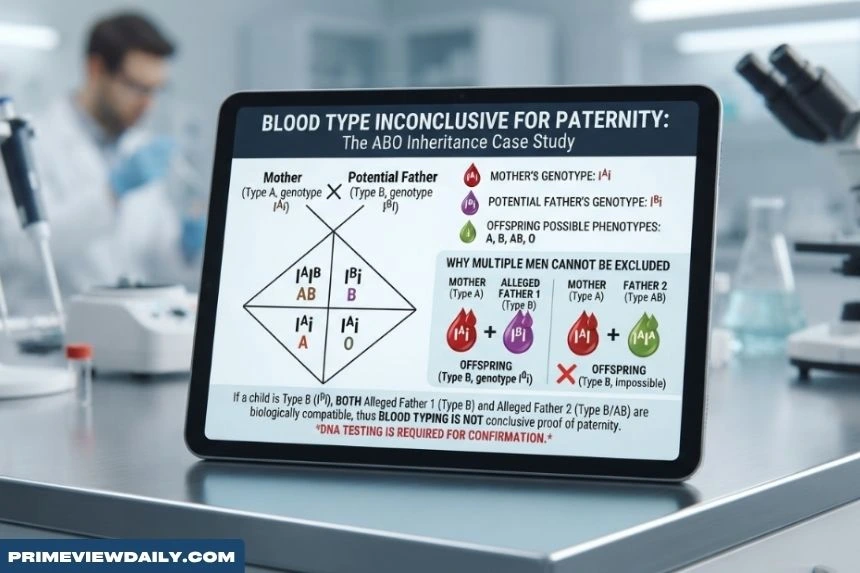
Can blood type determine paternity? No—not with certainty. Blood type may exclude an alleged father in some cases. However, it cannot prove that a particular man is the biological father.
Blood-group comparisons were useful before modern DNA testing. Today, a DNA paternity test provides the reliable answer. It usually needs only a cheek swab, not a blood draw.
Can Blood Type Determine Paternity or Only Exclude It?
Blood type can act as a basic exclusion tool. An exclusion means the child’s blood group does not fit the genetic contribution expected from the alleged father under ordinary inheritance rules.
By contrast, a compatible result does not establish paternity. It only shows that the alleged father could have contributed the required blood-group allele. Many unrelated men could produce the same compatible result.
| Question | What blood type can show |
| Is this combination possible? | Sometimes, under standard inheritance rules |
| Can it exclude an alleged father? | Sometimes |
| Can it identify the biological father? | No |
| Can it replace a DNA paternity test? | No |
A scientific study indexed by PubMed reached the same practical conclusion. Even ABO genotyping, which examines the ABO gene rather than only the visible type, was not sufficient for valid paternity testing.
How ABO Blood-Type Inheritance Works
The ABO system includes four familiar blood types: A, B, AB, and O. A child receives one ABO allele from each biological parent.
The system has three main alleles: A, B, and O. A and B can appear together because they are codominant. Meanwhile, O is usually recessive. The NCBI Bookshelf overview of the ABO group explains this inherited genetic structure.
| Visible blood type | Usual ABO genotype |
| A | AA or AO |
| B | BB or BO |
| AB | AB |
| O | OO |
These combinations explain why visible blood type gives limited information. Someone with type A may pass either an A allele or an O allele if their genotype is AO. Yet a routine blood-type result does not reveal which genotype that person carries.
Phenotype is not the same as genotype
The phenotype is the blood type reported by a routine test. The genotype is the pair of inherited ABO alleles behind that type.
This difference creates uncertainty. Two men may both have type A blood, but one may be AA while the other is AO. Their visible types match, although their possible genetic contributions differ.
Therefore, a blood-type match cannot identify a father. It does not compare enough unique genetic information. MedlinePlus explains blood typing mainly as a tool for safe transfusion, which remains its major clinical role.

Blood-Type Paternity Chart: Possible Child Types
The table below shows possible child types under the standard ABO model. It assumes accurate typing and excludes rare blood-group variants.
| Parent 1 | Parent 2 | Possible child blood types |
| O | O | O |
| O | A | O or A |
| O | B | O or B |
| O | AB | A or B |
| A | A | O or A |
| A | B | O, A, B, or AB |
| A | AB | A, B, or AB |
| B | B | O or B |
| B | AB | A, B, or AB |
| AB | AB | A, B, or AB |
This chart shows possibilities, not probabilities for a specific family. For example, two type A parents might have an O child only if both carry an O allele. If either parent is AA, that parent cannot pass O.
Likewise, an A parent and a B parent could have a child with any ABO type. That broad compatibility demonstrates why blood groups have weak identifying power. can blood type determine paternity
When Can Blood Type Exclude Paternity?
A blood-group exclusion appears when the child needs an allele the alleged father cannot provide after accounting for the mother’s contribution. However, the conclusion applies only to ordinary ABO inheritance.
Before acting on an apparent mismatch, confirm that every recorded type is correct. Then use a properly conducted DNA test. Rare variants and medical circumstances can produce unexpected typing results.
Example 1: AB alleged father and O child
A person with AB blood normally carries one A allele and one B allele. Therefore, he can pass A or B, but not O.
A type O child normally receives an O allele from each parent. Under the standard model, an AB man cannot be the biological father of an O child. Still, a qualified laboratory should investigate the case because uncommon blood phenotypes can complicate a simple chart. can blood type determine paternity
Example 2: Two O parents and a non-O child
People with ordinary type O blood usually have the OO genotype. Each parent can therefore pass only O. Under standard inheritance, two O parents should have an O child.
An A, B, or AB result in the child would be unexpected. Nevertheless, the family should not draw an immediate personal conclusion. First, repeat the blood typing and use DNA relationship testing if parentage needs confirmation.
Blood type examines a small, widely shared inherited trait. Millions of people have type A, B, AB, or O blood. Thus, a compatible type cannot distinguish one possible father from many others.
Why Blood Type Cannot Confirm Paternity
In addition, A and B phenotypes hide two possible genotypes. A routine result cannot show whether an A person is AA or AO. The same problem applies to BB and BO. can blood type determine paternity
DNA paternity testing instead compares many genetic markers inherited across the genome. The child’s non-maternal markers should match the biological father’s contribution. Laboratories then calculate the statistical strength of that relationship.
For a general background, the DNA paternity testing overview on Wikipedia describes the move from early blood typing to modern genetic-marker analysis. However, legal decisions should rely on official requirements and accredited laboratory reports, not an online overview.
Can Rh Factor Determine Paternity?
Rh-positive or Rh-negative information may add another inherited clue. Yet Rh factor cannot confirm paternity either.
The familiar plus or minus sign usually refers to the presence or absence of the RhD antigen. However, the wider Rh system involves closely linked genes and multiple antigens. Therefore, a one-line “positive versus negative” rule can oversimplify inheritance.
ABO and Rh results together may exclude some combinations. Still, many unrelated people remain compatible. A mismatch should trigger professional review rather than an accusation.
Rh typing also serves important pregnancy and transfusion purposes that are separate from paternity. Blood-group compatibility answers a medical question; DNA relationship testing answers the biological-parentage question.
Rare Exceptions That Can Mislead a Blood-Type Chart
Basic ABO charts describe common inheritance, not every human blood-group variant. One important exception is the Bombay phenotype. A person with this rare phenotype may appear type O even after inheriting an A or B allele.
The NCBI chapter on the Hh blood group specifically explains how this phenotype can mislead paternity interpretation. Other weak ABO subgroups and uncommon genetic arrangements may also produce surprising results.
Furthermore, sample or record errors can occur. A recent transfusion, certain illnesses, or a stem-cell transplant may also complicate how a blood type appears. These situations require professional laboratory interpretation.
Rare exceptions do not make the standard chart useless. Instead, they show why it should remain a screening clue rather than a family verdict. If the result matters, verify the blood types and proceed to DNA testing. can blood type determine paternity
DNA Testing Gives the Reliable Paternity Answer
Modern paternity tests compare inherited DNA markers. Usually, a technician or test participant collects cells from inside the cheek with a swab. Therefore, “DNA test” does not necessarily mean “blood test.” can blood type determine paternity
The U.S. Department of State’s relationship-testing guidance calls DNA testing the most accurate widely available technology for biological relationships. It also states that cheek-swab DNA testing can be equivalent in accuracy to DNA testing from blood.
For U.S. immigration cases, the Department describes a strict process involving an AABB-accredited laboratory and controlled sample handling. Requirements for other legal matters vary by jurisdiction. Therefore, contact the relevant court, agency, lawyer, or accredited laboratory before ordering a test. can blood type determine paternity
Home test versus legal paternity test
A home test may provide personal information when participants collect their own samples. However, self-collection generally cannot prove whose samples entered the kit.
A legal test uses identity checks, documented collection, secure handling, and chain of custody. Those controls connect each sample to the correct tested person. The AABB relationship-testing FAQs explain why accredited procedures matter.
If a result may affect custody, support, inheritance, citizenship, or immigration, check the required process first. AABB also publishes a current directory of accredited relationship-testing facilities.

Frequently Asked Questions
1. Can blood type determine paternity with certainty?
No. Blood type can sometimes exclude an alleged father under standard inheritance. However, only appropriate DNA relationship testing can establish strong evidence of biological paternity. can blood type determine paternity
2. Can matching blood types prove paternity?
No. A match only means the combination may be genetically possible. Many unrelated men share the same blood type. can blood type determine paternity
3. Can different blood types rule out the father?
Sometimes. A combination may be incompatible under ordinary ABO inheritance. Still, repeat the typing and use DNA testing before reaching a conclusion.
4. Can two O-positive parents have an A-positive child?
Under standard ABO inheritance, two ordinary type O parents produce type O children. An A result is unexpected and needs laboratory review because errors and rare phenotypes exist.
5. Can an AB father have an O child?
Under the standard ABO model, no. An AB father normally has no O allele to pass. Rare blood-group exceptions mean DNA testing should confirm any real case.
6. Does Rh-negative blood prove someone is not the father?
Not by itself. Rh inheritance can provide limited exclusion information, but the Rh system is complex. It cannot identify a biological father.
7. Is a cheek-swab paternity test accurate?
Yes, when a qualified laboratory performs a suitable DNA test. The DNA in cheek cells can support the same relationship analysis as DNA obtained from blood.
8. Does the mother need to participate in DNA testing?
Many direct father-child tests can proceed without the mother. However, her sample may improve interpretation, and a laboratory or legal authority may require it in some cases.
9. Can a home paternity test be used in court?
Usually, a self-collected test lacks the verified identity and chain of custody required for legal evidence. Court rules vary, so confirm local requirements before testing.
10. What should I do if the blood-type chart shows a mismatch?
Do not treat the chart as a final verdict. Confirm the recorded blood types, discuss unusual results with a qualified professional, and arrange an accredited DNA test if needed. can blood type determine paternity
Conclusion: Can Blood Type Determine Paternity?
Can blood type determine paternity? It can sometimes show that paternity is unlikely or incompatible under standard ABO rules. Nevertheless, it cannot prove that a particular man is the father. can blood type determine paternity
Use a blood-type chart only as an educational clue. For a dependable answer, choose DNA relationship testing. Moreover, follow official chain-of-custody requirements whenever the result may have legal consequences.
This article provides general educational information. It is not medical or legal advice. can blood type determine paternity
Read More At Prime View Daily