



Ethical egoism is the normative moral theory that people ought to act in their own self-interest. It does not claim that everyone already behaves selfishly. Moreover, it can support honesty, cooperation, friendship, or helping when those actions advance the agent’s long-term good.
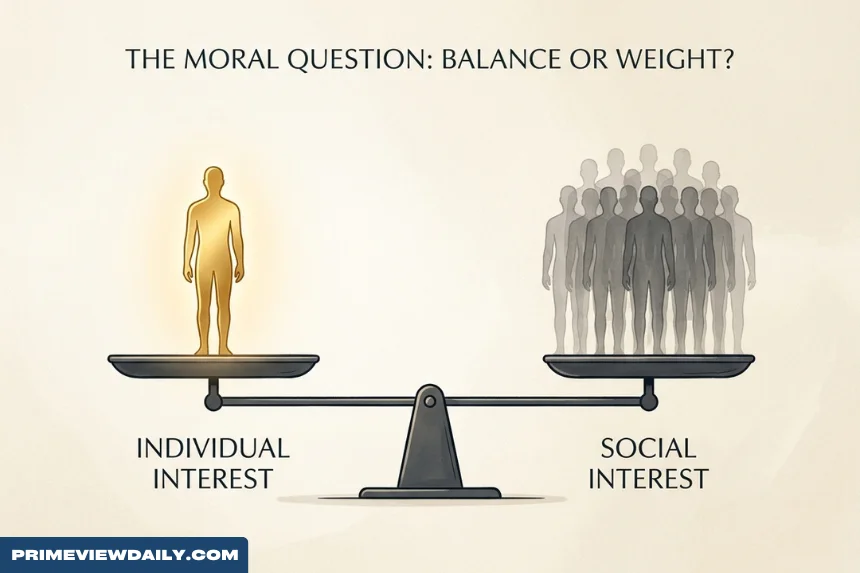
The theory asks whether your well-being should supply the decisive moral reason for action. Supporters say this focus protects autonomy and responsibility. However, critics ask why another person’s suffering should matter when helping offers you no benefit.
Ethical Egoism at a Glance
| Question | Quick answer |
|---|---|
| What is ethical egoism? | The moral view that an agent ought to promote that agent’s own self-interest. |
| What type of theory is it? | A normative ethical theory because it states how people ought to act. |
| Does it mean “do whatever you want”? | No. A passing desire may conflict with health, achievement, relationships, or long-term welfare. |
| Can it recommend helping others? | Yes. Helping may strengthen relationships, bring fulfillment, or protect a community the agent values. |
| How does it differ from psychological egoism? | Ethical egoism says people ought to pursue self-interest; psychological egoism says they always ultimately do. |
| Who is its best-known modern defender? | Ayn Rand, although her Objectivist ethics is a specific form of rational egoism. |
| What is its main strength? | It emphasizes autonomy, self-responsibility, and long-term planning. |
| What is its main problem? | It must justify giving the agent’s welfare decisive weight over everyone else’s. |
What Is Ethical Egoism?
Ethical egoism says that an action is morally right when, and because, it best promotes the acting person’s own good. In the strongest act-based version, a person must choose the available action that maximizes their self-interest. The overview of egoism from the Internet Encyclopedia of Philosophy also notes weaker versions, so not every formulation treats a failure to maximize personal benefit as automatically immoral.
The view is agent-relative. In other words, it can tell you to protect your interest while telling me to protect mine. Therefore, it does not ask each of us to maximize one shared pool of welfare.
Some variants evaluate rules or character traits instead of isolated actions. For example, a rule egoist might defend promise-keeping because stable cooperation serves the person better than case-by-case calculation. Nevertheless, self-interest remains the justification.
Key facts
| Feature | Explanation |
| Branch of philosophy | Normative ethics |
| Central moral standard | The agent’s own good, welfare, or self-interest |
| Typical time horizon | Long term, not merely immediate gratification |
| View of other people’s welfare | It can matter instrumentally or as part of the agent’s good, but not necessarily as an independent moral end |
| Common forms | Personal, individual, and universal ethical egoism |
| Main modern association | Ayn Rand’s defense of rational self-interest |
| Philosophical status | A debated theory, not an established fact or consensus position |
How Does Ethical Egoism Differ From Related Theories?
Ethical egoism is easy to confuse with several neighboring ideas. However, each one answers a different question about motives, reasons, or value.
| Theory | Kind of claim | Core idea |
| Ethical egoism | Moral and normative | A person morally ought to promote their own self-interest. |
| Psychological egoism | Descriptive | Every person’s ultimate motives are self-interested. |
| Rational egoism | Normative, but not necessarily moral | A person has decisive rational reason to promote their own good. |
| Hedonism | A theory of value or well-being, depending on the version | Pleasure is the only or primary intrinsic good. |
| Ethical altruism | Moral and normative | Other people’s interests can independently create duties to help or sacrifice. |
| Utilitarianism | Impartial and normative | The right action promotes overall well-being, without automatically favoring the agent. |
The crucial contrast concerns “is” and “ought.” Psychological egoism tries to describe people’s ultimate motivation. Ethical egoism, by contrast, evaluates what they morally should do.
Why does psychological egoism not prove ethical egoism?
Even if every human action arose from self-interest, that fact would not show that self-interested action is morally right. The argument needs another premise, such as “people morally ought to do whatever they are naturally motivated to do.” Yet that premise is doubtful because people can have natural motives that are reckless, cruel, or dishonest.
Moreover, psychological egoism remains controversial. Someone can enjoy helping while ultimately aiming at another person’s welfare. Therefore, receiving a benefit does not prove it was the final purpose.
What Does “Self-Interest” Mean?
Self-interest means what genuinely improves a person’s life, but its content is disputed. Desire accounts emphasize satisfied desires, while hedonistic accounts emphasize pleasure. Meanwhile, objective-list accounts may include health, knowledge, friendship, achievement, or virtue.
Hybrid accounts combine those approaches. Consequently, two ethical egoists can recommend different actions because they use different theories of well-being.
Self-interest is not identical to appetite. A student may want to skip every class, yet attending may better serve the student’s future freedom and goals. Similarly, a quick dishonest profit may threaten reputation, relationships, legal security, and peace of mind.
However, long-term language cannot remove every hard case. A hypothetical action might benefit the agent without punishment, guilt, or reputational loss while seriously harming someone else. Such cases test whether the theory rejects wrongdoing in principle or only when wrongdoing eventually costs the wrongdoer.

What Are the Three Forms of Ethical Egoism?
Introductory textbooks often describe personal, individual, and universal forms. The labels are not used uniformly, so their definitions matter more than their names.
| Form | Claim |
| Personal ethical egoism | I ought to pursue my own interest, but I make no claim about what anyone else ought to do. |
| Individual ethical egoism | Everyone ought to advance the interests of one specified person, usually the speaker. |
| Universal ethical egoism | Every person ought to pursue that person’s own interest. |
Universal ethical egoism is usually the intended theory in contemporary introductions. It applies one agent-relative rule to everyone. By contrast, individual egoism grants a uniquely favored position to one person and therefore faces an especially obvious consistency and fairness problem.
Which Thinkers Are Associated With Ethical Egoism?
No single thinker invented every form. Instead, later debates connect several philosophers’ accounts of self-interest, autonomy, or rational choice to egoism.
| Date | Thinker or work | Connection and caveat |
| 1651 | Thomas Hobbes, Leviathan | Self-preservation and mutual advantage help explain rules and political authority. However, labeling Hobbes a simple ethical egoist compresses a much broader theory. |
| 1844 | Max Stirner, Der Einzige und sein Eigenthum | Stirner attacks fixed moral ideals and imagines a radical egoistic alternative centered on individual “ownness.” Some editions use 1845, but scholars commonly date the original German publication to 1844. |
| 1874 | Henry Sidgwick, The Methods of Ethics | Sidgwick systematically compares egoistic hedonism with intuitionism and universalistic hedonism. Nevertheless, he was a major utilitarian, not merely an advocate for egoism. |
| 1964 | Ayn Rand, The Virtue of Selfishness | Rand defends rational self-interest within Objectivism. Her view rejects both sacrificing oneself to others and sacrificing others to oneself. |
The account of Thomas Hobbes’s moral and political philosophy warns that the label can oversimplify his conclusions. Hobbes uses self-interest to explain why rational people accept covenants and government, not why every advantageous act is moral.
Stirner’s The Ego and His Own radically challenges moral authority. Yet attacking fixed obligations does not map neatly onto a theory that makes self-interest a universal moral duty.
Sidgwick’s The Methods of Ethics placed egoistic hedonism beside intuitionism and utilitarianism. Ultimately, he found tension between personal and universal happiness.
Is Ayn Rand’s egoism the same as ordinary selfishness?
No. Independent accounts of Ayn Rand’s ethical theory describe a form of rational egoism grounded in human life, reason, productive achievement, and principled action. Rand did not define self-interest as obeying every impulse or exploiting other people.
Her essay “The Objectivist Ethics” presents rational selfishness as an alternative to whim and short-term predation. Still, this is Rand’s own defense of Objectivism, not proof that the argument succeeds. Critics continue to question how she moves from facts about human survival to a binding moral standard.
What Are Real-Life Examples of Ethical Egoism?
Ethical egoism can recommend familiar conduct, but it gives that conduct a distinct justification. The decisive question is not simply who benefits. Instead, it is whether the action best advances the agent’s own good.
| Scenario | Possible egoist recommendation | Reason and pressure point |
| Studying instead of going out | Study | Education may support achievement, income, and future choice, although the immediate option feels better. |
| Keeping an inconvenient promise | Keep it | Trust and a reliable character support long-term cooperation. However, a secret one-time breach may create a harder case. |
| Donating to a local shelter | Donate | The gift may bring meaning, strengthen a valued community, or help people the donor loves. Yet need alone does not supply the egoist’s ultimate reason. |
| Returning a lost wallet | Return it | Integrity, guilt avoidance, reputation, and social trust may favor returning it. The test becomes sharper if the owner cannot identify the finder and the finder would feel no guilt. |
| Taking a secret profit that harms a stranger | It may require taking the profit under a strict act version | If the agent gains and faces no countervailing cost, ordinary long-term defenses disappear. Therefore, the case exposes the theory’s departure from common moral judgment. |
Other theories can recommend the same act for different reasons. A utilitarian may favor the overall outcome, while a deontologist sees promise-keeping as a duty. By contrast, an egoist focuses on the promisor’s good.
What Are the Main Arguments for Ethical Egoism?
The strongest arguments emphasize knowledge, autonomy, cooperation, and theoretical simplicity. However, each argument must establish more than the value of reasonable self-care.
People usually know their own needs best
Individuals normally have better access to their goals, limits, and circumstances than distant observers do. Therefore, letting each person manage their life may reduce paternalistic mistakes.
Nevertheless, this point shows only that people are often well placed to pursue their interests. It does not show that they should ignore independently important needs of others.

Self-responsibility protects autonomy
Ethical egoism resists moral demands that treat a person as a resource for everyone else. Moreover, it recognizes that health, projects, relationships, and happiness deserve serious weight.
Critics can accept that insight without accepting exclusive egoism. A pluralist theory may protect personal projects while also recognizing limited duties to other people.
Long-term interest supports cooperation
People need trust, friendship, exchange, and security. Consequently, an enlightened egoist often has reason to keep promises, avoid violence, and help reliable partners.
The difficulty appears when another person cannot reciprocate, retaliate, or affect the agent’s reputation. In that situation, the cooperation argument may no longer support an ordinary duty.
One standard can unify familiar duties
Self-interest offers a simple explanation for honesty, prudence, and restraint: these practices generally improve the agent’s life. Simplicity can make a theory attractive because it reduces many rules to one principle.
However, a simple theory is not automatically a true one. If the principle approves profitable exploitation, its elegance may become a weakness rather than a virtue.
What Are the Strongest Objections to Ethical Egoism?
Critics say the theory gives the self unexplained priority, can approve harm, and struggles as a shared morality. Its defenders’ replies often narrow rather than eliminate these problems.
It may privilege the self arbitrarily
Why should my pain matter decisively while equally intense pain in another person has no independent moral weight? James Rachels frames a version of this challenge as unjustified discrimination in favor of a “group of one.”
An egoist can invoke agent-relative reasons. Nevertheless, that explains the theory’s structure without showing why morality should adopt it.
It can recommend profitable wrongdoing
Suppose an agent can steal, deceive, or exploit without detection, guilt, damaged character, or future risk. A strict maximizing version appears to require the profitable act.
Supporters often answer that real wrongdoing carries hidden costs. Usually it does. However, the hypothetical deliberately removes those costs to ask whether another person’s loss matters in itself.
It does not impartially resolve conflicts
Two business rivals may each have reason to win the same exclusive contract. Ethical egoism can tell each to pursue victory, even though both cannot obtain it.
This result is not a formal contradiction because a theory can assign different duties to different agents. Still, it offers no neutral principle for deciding whose competing interest should prevail.
Publicity can work against the egoist
An egoist may benefit if other people remain honest, generous, and self-sacrificing. Therefore, public acceptance of the theory may work against the agent who accepts it.
A defender can reply that truth and beneficial publicity are separate issues. Yet a moral theory that works best when hidden has difficulty serving as a public standard for mutual justification.
Individual advantage can become collectively self-defeating
Prisoner’s dilemmas, free riding, and overused resources show how tempting choices can leave everyone worse off. Rules and repeated interaction often align interests. Even so, one-time cases can preserve an incentive to defect.
It may distort friendship and love
Friendship seems to involve caring about another person for that person’s sake. If every concern becomes merely a tool for one’s own welfare, the relationship can appear calculating.
An egoist may reply that loved ones become part of a flourishing life. However, this stretches self-interest toward genuine other-concern and blurs the theory’s boundary.
People can misidentify their own good
Addiction, bias, poor information, and short-term thinking can all distort judgment. Therefore, even a person who accepts the theory may not know what it recommends.
Every outcome-based theory faces uncertainty. Nevertheless, this one needs a credible account of welfare before it can guide difficult choices.
Can an Ethical Egoist Genuinely Care About Other People?
Yes, but the reason for that care matters. An egoist can value someone instrumentally because the person provides companionship, support, or opportunity. Moreover, another person’s happiness can become a constitutive part of the agent’s own flourishing, as it often does in close relationships.
The deepest tension arises with independent concern. If I have reason to relieve a stranger’s suffering solely because that person is suffering, then the stranger’s welfare supplies a moral reason that does not depend on my benefit. Consequently, exclusive ethical egoism would no longer tell the whole moral story.
Is Ethical Egoism a Convincing Moral Theory?
Ethical egoism captures important truths about autonomy, self-care, foresight, and cooperation. It also challenges demands for unlimited sacrifice. Therefore, dismissing it as greed misses its strongest contribution.
However, valuing self-interest does not prove that only self-interest matters. The hardest counterexamples remove punishment, guilt, and reputation while leaving another person vulnerable to harm. Ultimately, the theory remains least convincing where ordinary moral judgment sees another person’s need or dignity as a reason in its own right.
Frequently Asked Questions
1. What is ethical egoism in simple terms?
Ethical egoism says a person morally ought to pursue their own genuine self-interest. However, it usually concerns long-term well-being rather than every immediate desire.
2. What is a real-life example of ethical egoism?
A person may keep a difficult promise because reliability protects trust, reputation, and future cooperation. Another theory may recommend the same act, but the egoist’s ultimate reason is the benefit to the promisor.
3. How is ethical egoism different from psychological egoism?
Ethical egoism says people ought to act in their self-interest. Psychological egoism instead claims that all ultimate human motivation already is self-interested.
4. Is ethical egoism the same as selfishness?
Not exactly. Ordinary “selfishness” often implies greed, short-term thinking, or disregard for others, whereas ethical egoism can recommend restraint, honesty, and cooperation.
5. What are the three forms of ethical egoism?
They are commonly called personal, individual, and universal ethical egoism. However, textbook labels vary, so the precise definitions are more important than the names.
6. Who is the best-known supporter of ethical egoism?
Ayn Rand is the best-known modern defender of rational self-interest. Nevertheless, Max Stirner and Henry Sidgwick also play important but very different roles in the history of egoistic thought.
7. Can an ethical egoist help other people?
Yes. Helping can support friendship, meaning, reputation, reciprocal aid, or a valued community; however, the agent’s own good supplies the ultimate justification.
8. What is the strongest argument for ethical egoism?
Its strongest case combines autonomy with the fact that people usually understand and manage their own lives better than outsiders do. Still, this supports giving self-interest substantial weight, not necessarily exclusive moral weight.
9. What is the strongest objection to ethical egoism?
The strongest objection is that the theory gives one person’s welfare priority without identifying a morally relevant difference between that person and everyone else. Profitable-wrongdoing cases make that concern concrete.
10. Is ethical egoism the same as capitalism?
No. Some defenses of capitalism emphasize self-interest and voluntary exchange, but a political-economic system and a complete moral theory are different ideas. Therefore, neither one logically entails the other.
Conclusion
Ethical egoism makes self-interest morally central and offers a forceful defense of autonomy, responsibility, and long-term thinking. However, its central challenge remains unresolved: why should another person’s welfare count only when it contributes to the agent’s good? The theory explains much prudent and cooperative behavior, but critics argue that morality must also recognize reasons grounded in other people’s needs, rights, and dignity.