


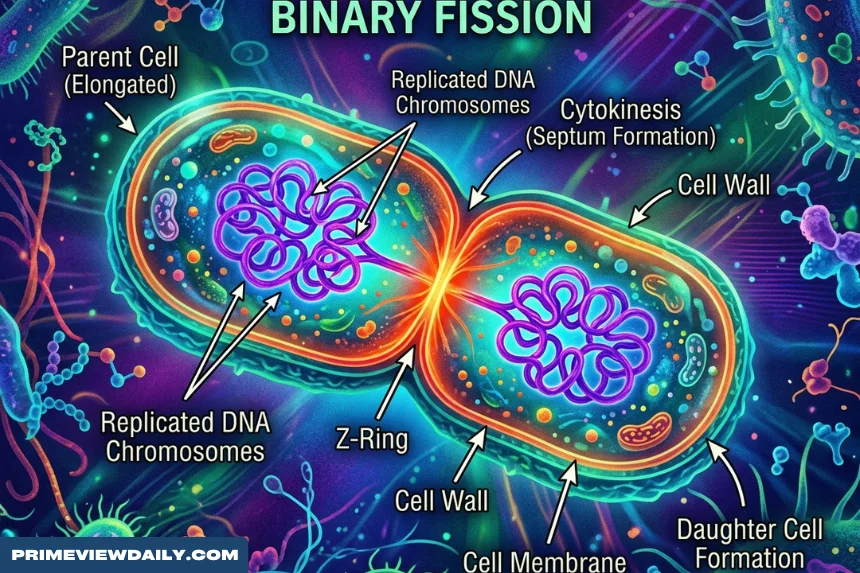
Binary fission is a form of cell division and asexual reproduction in which one parent cell divides to produce two daughter cells. Bacteria commonly reproduce this way: they copy their genetic material, separate the DNA copies, organize a division site, build a septum, and split into two cells.
Although textbooks often call the daughter cells “genetically identical,” that description assumes no new mutation occurs. Moreover, binary fission differs from mitosis because bacteria have no membrane-bound nucleus to divide and do not use the mitotic spindle system found in eukaryotic cells.
Quick Answer: What Is Binary Fission?
| Question | Answer |
|---|---|
| What is binary fission? | A process in which one cell divides into two daughter cells |
| Type of reproduction | Asexual reproduction in unicellular organisms |
| Common in | Bacteria and many archaea |
| Number of parent cells | One |
| Number of daughter cells | Two |
| DNA replication required? | Yes |
| Mitosis required in bacteria? | No |
| Important division protein | FtsZ in many bacteria |
| Main dividing structure | Septum |
| Genetic result | Usually very similar daughter cells, except for mutations or other genetic changes |
| Can protists use it? | Yes, some unicellular eukaryotes divide by fission |
| Population effect | Repeated division can produce exponential growth |
The simplest definition is therefore: one cell copies its genetic material and splits into two new cells.
Key Facts About Binary Fission
| Feature | Key fact |
|---|---|
| Meaning of “binary” | Two |
| Meaning of “fission” | Splitting |
| Main role in bacteria | Cell reproduction |
| DNA location in bacteria | Nucleoid region rather than a nucleus |
| Typical bacterial chromosome | Often circular, although exceptions exist |
| Cytoplasmic division | Cytokinesis |
| FtsZ function | Helps organize the bacterial division site in many species |
| Divisome | Protein machinery that coordinates cell division |
| Growth pattern | Can produce exponential population growth |
| Example organism | Escherichia coli |
| Different from mitosis? | Yes |
OpenStax describes binary fission as the most common mechanism of bacterial cell replication and explains how DNA replication, chromosome separation, FtsZ, and septum formation contribute to division.
How Does Binary Fission Work?
Binary fission coordinates cell growth, DNA copying, chromosome segregation, and physical separation. Textbooks often divide the process into four or five steps, while molecular microbiology may describe additional intermediate events.
For a detailed textbook treatment, the OpenStax guide to microbial growth explains bacterial DNA replication, FtsZ-ring formation, septum development, and daughter-cell separation.
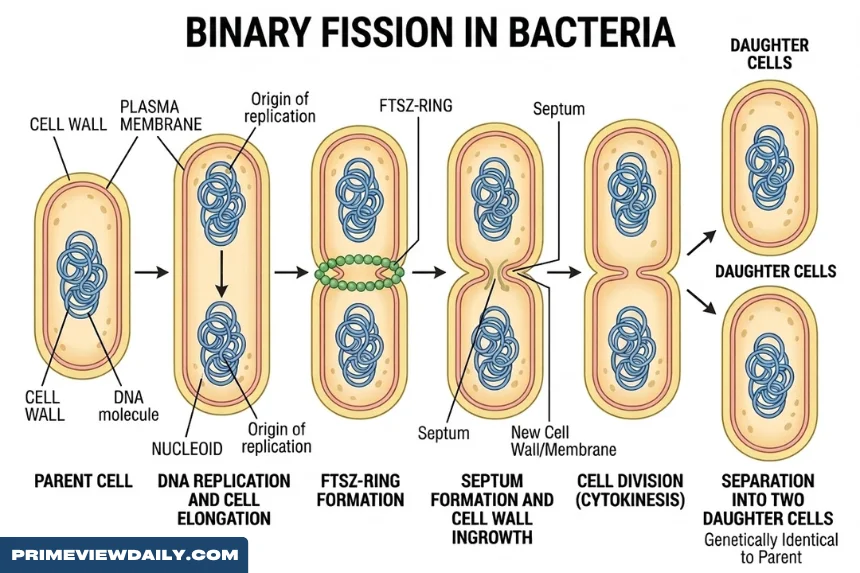
Step 1: The Cell Grows
Before division, a bacterial cell must prepare enough cellular material for two daughter cells.
The cell increases its mass and makes proteins, ribosomes, membrane components, and other materials. Meanwhile, cell-cycle processes coordinate growth with chromosome replication and division.
Therefore, binary fission involves much more than simply “pinching a bacterium in half.”
Step 2: DNA Replication Begins
Next, the cell copies its chromosome.
In a standard bacterial model with a circular chromosome, DNA replication starts at an origin of replication. Replication then proceeds until the cell produces the DNA copies that the daughter cells need.
However, not every bacterial genome fits the one-circular-chromosome diagram. OpenStax notes, for example, that Borrelia burgdorferi carries a linear chromosome.
Consequently, students should learn the circular chromosome as the classic model without treating it as an absolute rule.
Step 3: The Chromosome Copies Separate
As the cell grows, it organizes the replicated genetic material so that each future daughter cell can inherit a complete genome.
This stage differs sharply from mitosis. Bacteria do not line chromosomes up on a metaphase plate, nor do they use a mitotic spindle to pull sister chromatids apart.
Instead, bacterial chromosome segregation involves its own molecular systems.
Ultimately, successful segregation keeps the division machinery from trapping the genome on the wrong side of the developing partition.
What Does FtsZ Do During Binary Fission?
In many bacteria, FtsZ helps organize the site where the cell will divide. The protein forms a dynamic ring-like structure around the future division plane.
Researchers call this structure the Z ring.
FtsZ shares structural ancestry with tubulin, a key component of the eukaryotic cytoskeleton. However, bacterial division does not simply reproduce mitosis on a smaller scale.
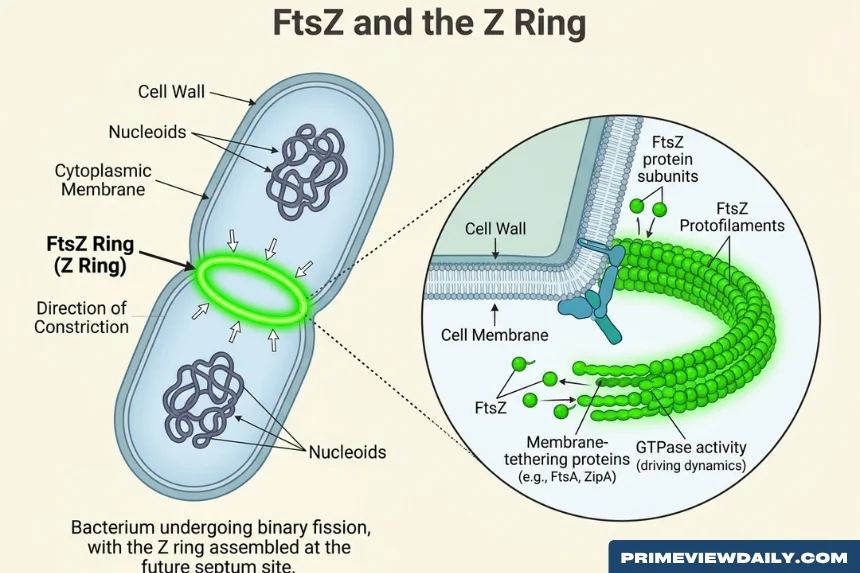
Step 4: The Z Ring and Divisome Organize Division
FtsZ gathers near the future division site in many bacteria.
Other proteins then assemble around this structure and form a larger cell-division system called the divisome. This machinery coordinates changes in the membrane and cell wall.
A 2024 Nature Reviews Microbiology review describes FtsZ as an ancient tubulin homolog that organizes division machinery at the midpoint in many bacterial species.
However, biology contains exceptions. Researchers have found groups of bacteria and archaea that do not rely on the classic FtsZ system. Therefore, “many bacteria use FtsZ” is more accurate than “all prokaryotes use FtsZ.”
Step 5: A Septum Forms
Next, the cell begins separating its two future halves.
The division machinery guides inward growth of the cell envelope. In many bacteria, new peptidoglycan contributes to the developing septum, or partition, between the daughter cells.
The NCBI Bookshelf discussion of bacterial cytokinesis explains that FtsZ-associated division proteins guide inward growth of the membrane and cell wall.
As a result, the two halves become increasingly distinct.
Step 6: Two Daughter Cells Separate
Finally, the cell completes the septum and separates.
Each viable daughter needs the genetic material and cellular machinery required for continued life. Once division finishes, each cell can grow and potentially begin another cycle.
Therefore, one parent cell becomes two, two can become four, four can become eight, and the population may grow rapidly when environmental conditions support division.
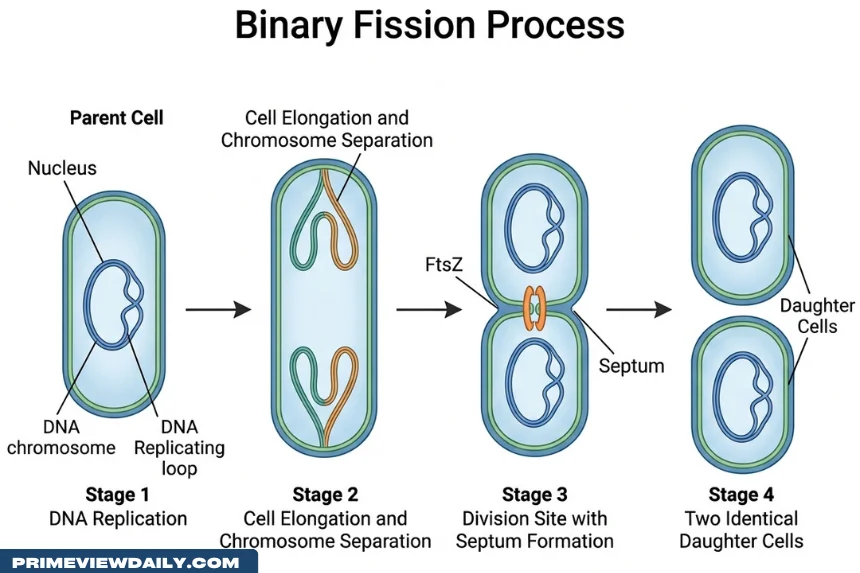
Binary Fission Diagram: What Should It Show?
A useful binary fission diagram should show the process in sequence rather than simply displaying a parent and two daughter cells.
At minimum, label:
Parent cell → DNA replication → cell elongation and chromosome separation → division site or septum → two daughter cells
For more advanced students, add origin of replication, nucleoid, FtsZ ring, divisome, plasma membrane, cell wall, and septum.
However, avoid drawing the bacterial chromosome inside a nucleus. Bacteria do not have a membrane-bound nucleus; instead, their chromosome occupies a nucleoid region.
Is Binary Fission a Form of Asexual Reproduction?
Yes, when a unicellular organism uses binary fission to produce new individuals, it represents asexual reproduction.
Only one parent participates, and the process does not require the fusion of gametes.
For a unicellular bacterium, cell division also creates new organisms. Therefore, bacterial division increases the number of individuals in the population.
Khan Academy describes prokaryotic reproduction as asexual and explains that bacteria and archaea commonly reproduce through this process.
Are the Daughter Cells Perfect Clones?
Usually, they closely resemble the parent genetically.
However, “identical” does not mean that biological variation becomes impossible. DNA-copying errors can produce mutations, and environmental factors may also damage DNA.
Moreover, bacteria can exchange genetic material independently of binary fission through transformation, transduction, and conjugation.
Therefore, rapid asexual reproduction does not prevent bacterial evolution.
Binary Fission vs Mitosis: What Is the Difference?
Binary fission and mitosis both help cells distribute copied DNA, but they use different cellular systems.
Bacterial binary fission occurs without a membrane-bound nucleus or mitotic spindle. Mitosis, by contrast, separates duplicated nuclear chromosomes in eukaryotic cells.
The Khan Academy binary fission explanation provides a student-friendly comparison between the two processes.
Binary Fission vs Mitosis Table
| Feature | Binary fission in bacteria | Mitosis |
|---|---|---|
| Cell type | Prokaryotic | Eukaryotic |
| Nucleus | Absent | Present |
| Nuclear division | No | Yes |
| Mitotic spindle | No | Yes |
| Typical chromosome model | Circular bacterial chromosome | Multiple linear chromosomes |
| Main division protein discussed | FtsZ in many bacteria | Tubulin-based spindle system |
| Result | Two daughter cells | Two daughter cells |
| Role | Reproduction of unicellular bacteria | Growth, repair, or reproduction depending on organism |
OpenStax emphasizes that prokaryotic cells do not need mitotic nuclear division because they have no true nucleus.
Do Amoeba and Other Protists Use Binary Fission?
Some unicellular eukaryotes also reproduce by dividing into two cells, and biologists may describe that reproductive pattern as binary fission.
However, these organisms are eukaryotes. Consequently, they must also divide their nuclear genetic material rather than following bacterial chromosome-division machinery.
OpenStax notes that some unicellular eukaryotes undergo binary fission through mitosis.
Transverse and Longitudinal Binary Fission
Biology texts sometimes classify protist fission according to the direction in which a cell divides.
In transverse fission, division runs across the cell’s principal axis. In longitudinal fission, it runs along that axis.
OpenStax specifically describes transverse and longitudinal forms among protists.
Therefore, students should avoid mixing these whole-organism eukaryotic classifications with the molecular steps of bacterial division.
Binary Fission Examples
Bacteria provide the most familiar examples.
Escherichia coli, for instance, serves as one of biology’s most heavily studied bacterial models. Under favorable laboratory conditions, it can divide extremely rapidly.
Other prokaryotes also use fission-based cell division, although their chromosomes and molecular machinery do not all follow one identical blueprint.
Example: E. coli
Under optimal laboratory growth conditions, E. coli can double in about 20 minutes.
That figure does not mean every E. coli cell everywhere divides every 20 minutes. Temperature, nutrients, oxygen availability, strain, stress, and other environmental conditions change growth rates substantially.
Therefore, the famous 20-minute figure describes favorable laboratory conditions, not a universal biological clock.
What Is Generation Time in Binary Fission?
Generation time, or doubling time, describes how long a microbial population takes to double through one round of division under defined conditions.
Suppose a bacterial population starts with 100 cells and every cell successfully divides once. The population becomes 200. After another round, it becomes 400.
The general growth relationship is:
Final population = Initial population × 2ⁿ
Here, n represents the number of completed generations.
Example of Binary Fission Population Growth
Imagine 100 bacteria with a 20-minute generation time under ideal conditions.
After two hours, 120 minutes have passed. Therefore:
120 ÷ 20 = 6 generations
The population would theoretically reach:
100 × 2⁶ = 6,400 cells
However, real bacterial cultures cannot keep doubling indefinitely. Eventually, nutrients fall, wastes accumulate, space changes, or other limiting factors slow population growth.
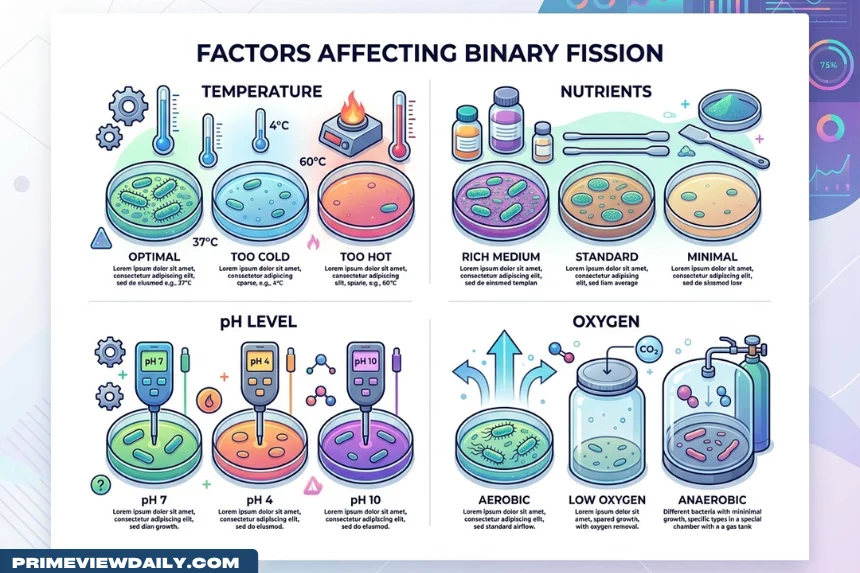
What Factors Affect the Rate of Binary Fission?
Bacteria divide fastest when environmental conditions support the metabolism and cellular processes required for growth.
Temperature matters because enzymes and membranes function within particular temperature ranges. Nutrient availability also matters because cells need raw materials and energy to build DNA, proteins, membranes, and other components.
In addition, pH and oxygen conditions can affect growth, although species have very different requirements.
Why Does Doubling Time Vary So Much?
Different species follow very different schedules.
OpenStax notes that E. coli can double in roughly 20 minutes under optimal laboratory conditions, whereas Mycobacterium tuberculosis may need about 15 to 20 hours.
Moreover, bacteria often grow much more slowly in nature than in nutrient-rich laboratory media. Research comparing laboratory and wild growth rates supports this distinction.
Consequently, never assume that all bacteria reproduce every 20 minutes.
Why Is Binary Fission Important?
Binary fission explains how many microbial populations increase and why bacterial numbers can rise quickly under favorable conditions.
The process matters in microbiology, medicine, food science, ecology, biotechnology, and laboratory research.
For example, rapid bacterial division can help a population colonize a suitable environment. Meanwhile, scientists exploit fast-growing laboratory bacteria such as E. coli to study genes and produce biological materials.
Does Binary Fission Cause Antibiotic Resistance?
Binary fission itself does not intentionally create antibiotic resistance.
However, every round of DNA replication provides an opportunity for mutations. If a mutation gives a bacterium a survival advantage under antibiotic exposure, natural selection may increase that variant’s frequency.
In addition, bacteria can acquire resistance genes through horizontal gene transfer. Therefore, antibiotic resistance involves mutation, gene exchange, selection, and population growth rather than binary fission alone.
Common Binary Fission Misconceptions
“All Bacteria Have One Circular Chromosome”
Many bacteria fit this textbook model, but not all do.
For example, Borrelia burgdorferi has a linear chromosome. Consequently, diagrams that show one circular chromosome provide a useful teaching model rather than a universal description of bacterial genetics.
“Binary Fission Is the Same as Mitosis”
It is not.
Bacteria lack a membrane-bound nucleus and do not use a mitotic spindle. Although both processes ultimately distribute copied DNA into daughter cells, their mechanisms differ substantially.
“The Daughter Cells Are Always 100% Identical”
They usually inherit highly similar genomes, but mutations can occur.
Therefore, “genetically identical except for new genetic changes” provides a more accurate description than claiming absolute identity.
“Every Bacterium Uses the Exact Same FtsZ Mechanism”
FtsZ plays a central role in many well-studied bacteria, including classic models.
However, scientists know exceptions, and cell-division machinery varies among prokaryotic groups. Nature reviews specifically note that FtsZ is widespread rather than universal.
Binary Fission in Bacteria: Simple Study Summary
For a test or quick revision, remember this sequence:
Growth → DNA replication → DNA segregation → division machinery → septum formation → daughter-cell separation
The critical idea is that the cell must copy and distribute its genome before completing physical separation.
Moreover, remember that bacterial binary fission does not include prophase, metaphase, anaphase, or telophase. Those names describe mitosis.
For additional study, the OpenStax prokaryotic cell division chapter explains the process at undergraduate level.
FAQs About Binary Fission
1. What is binary fission in simple words?
Binary fission is a process in which one cell divides into two cells. Bacteria commonly use it for reproduction, while some other unicellular organisms also reproduce through forms of fission.
2. What are the main steps of binary fission?
The cell grows, copies its DNA, separates the genetic material, organizes the division site, forms a septum, and separates into two daughter cells. However, researchers can divide the process into more detailed molecular steps.
3. Is binary fission sexual or asexual?
Binary fission is asexual reproduction when it produces new unicellular organisms. Therefore, it requires only one parent and does not involve the fusion of gametes.
4. What organisms reproduce by binary fission?
Bacteria provide the classic examples, and many archaea also reproduce through cell fission. In addition, some unicellular eukaryotes reproduce by dividing their whole cell into two, although their nuclear division differs from bacterial division.
5. What happens to DNA during binary fission?
The cell replicates its genome and separates the resulting copies before completing division. Consequently, each viable daughter cell receives the genetic information it needs.
6. Does binary fission produce identical daughter cells?
It normally produces daughter cells with very similar genetic information. However, mutations can arise during DNA replication, so the daughter cells are not guaranteed to remain perfectly identical.
7. What is the difference between binary fission and mitosis?
Binary fission in bacteria does not involve a nucleus or mitotic spindle. Mitosis divides nuclear chromosomes in eukaryotic cells and uses a tubulin-based spindle system to organize chromosome separation.
8. How fast can binary fission occur?
The rate varies widely. Under optimal laboratory conditions, E. coli can double in about 20 minutes, while other bacteria may take hours, days, or longer depending on species and environment.
9. What is FtsZ in binary fission?
FtsZ is a tubulin-related protein that helps organize cell division in many bacteria. It forms the Z ring, which helps establish the division site and recruit other proteins involved in building the new cell boundary.
10. Is binary fission the same as budding?
No. In binary fission, a parent usually divides into two roughly comparable daughter cells. In budding, a smaller new structure grows from the parent before separating, so the division starts asymmetrically.
Conclusion
Binary fission allows one cell to produce two daughter cells through coordinated growth, DNA replication, genetic segregation, and cell division. Bacteria provide the best-known examples, although other organisms and cellular systems can show forms of fission as well.
In the standard bacterial model, the cell copies its chromosome, organizes the genetic material into future daughter cells, uses division machinery such as FtsZ and the divisome, forms a septum, and completes separation. However, biology contains important exceptions, so not every bacterium has one circular chromosome or uses identical division machinery.
Moreover, binary fission differs from mitosis. Bacteria have no membrane-bound nucleus to divide and do not use a mitotic spindle. Nevertheless, both processes solve the same fundamental problem: giving new cells the genetic information they need.
Ultimately, understanding binary fission explains bacterial reproduction, exponential population growth, microbial evolution, and one of the most fundamental forms of cell division in biology.