


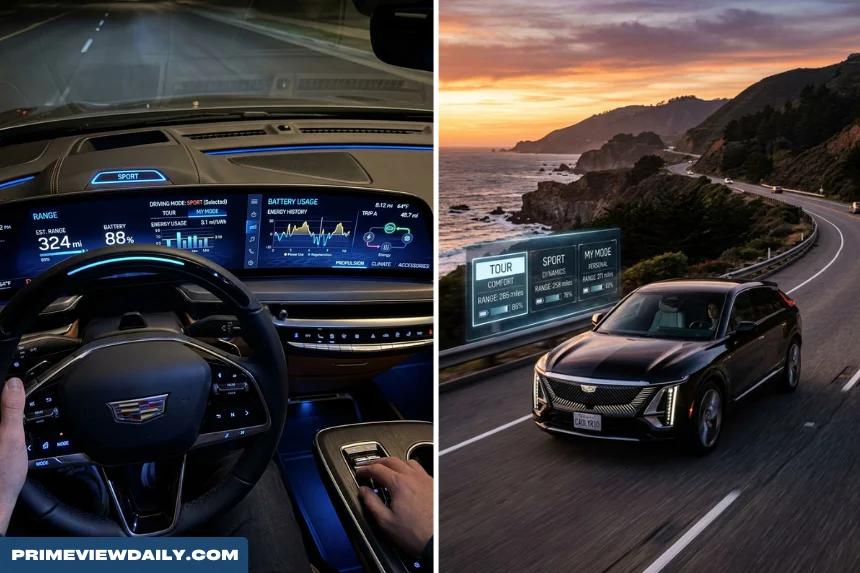
Do the driving modes in Cadillac LYRIQ offer different ranges or battery usages? They do not change the battery’s capacity or provide separate official EPA ranges. However, Tour, Sport, Snow/Ice, My Mode, and LYRIQ-V performance settings can influence real-world electricity consumption through accelerator tuning, traction behavior, performance settings, and the way a driver responds to them.
In practical terms, Sport may consume more battery when its sharper response leads to harder acceleration. Tour usually provides the most predictable baseline, while Snow/Ice prioritizes traction rather than efficiency. Meanwhile, a relaxed My Mode may support smoother driving, but Cadillac does not assign any mode a guaranteed range advantage.
Quick answer table
| Question | Answer |
|---|---|
| Primary question | Do the driving modes in Cadillac LYRIQ offer different ranges or battery usages? |
| Does mode selection change battery capacity? | No |
| Are there separate EPA ratings for Tour and Sport? | No |
| Can modes affect real-world consumption? | Yes, indirectly |
| Which setting is best for ordinary driving? | Tour |
| Does Sport always reduce range? | No, but aggressive acceleration usually increases energy use |
| Is Snow/Ice an efficiency mode? | No; it prioritizes traction |
| Can My Mode save battery? | Possibly, when configured for relaxed acceleration and driven smoothly |
| Is One-Pedal Driving a drive mode? | No; it is a separate regenerative-braking feature |
| What usually affects range most? | Speed, acceleration, weather, terrain, HVAC use, tires, and vehicle configuration |
LYRIQ range and battery facts
| Specification | Current verified information |
|---|---|
| Vehicle type | Battery-electric luxury SUV |
| Rated battery capacity | 102 kWh |
| 2026 single-motor RWD range | Up to 326 EPA-estimated miles |
| 2026 dual-motor AWD range | Up to 319 EPA-estimated miles on applicable configurations |
| 2026 LYRIQ-V range | 285 EPA-estimated miles |
| Standard drive modes | Tour, Sport, Snow/Ice, My Mode |
| Additional performance setting | V-Mode on LYRIQ-V |
| Energy-recovery features | One-Pedal Driving and Regen On Demand |
| Dedicated Eco mode | No |
| Mode-specific EPA ratings | None published |
Cadillac publishes range by model and hardware configuration. Therefore, an RWD LYRIQ and AWD LYRIQ may carry different ratings, while switching one vehicle from Tour to Sport does not transform it into a separately EPA-rated configuration.
What actually changes when you select another mode?
Driver Mode Control changes how the LYRIQ responds to the driver and road conditions. It does not add or remove electricity from the battery.
The selected setting may alter accelerator sensitivity, steering effort, suspension behavior, motor sound, adaptive cruise tuning, brake-pedal feel, or AWD power distribution. Consequently, the same physical accelerator movement may produce a different-feeling response in Sport than in Tour.
That distinction explains why two owners can record different battery usage in the same mode. One driver may use Sport while maintaining gentle accelerator inputs and moderate speeds. Another may repeatedly use the sharper response for rapid acceleration. Therefore, the second driver will probably consume substantially more energy even though both selected the same setting. Therefore, when owners ask, “do the driving modes in Cadillac LYRIQ offer different ranges or battery usages?” the answer depends mainly on how each mode changes vehicle response and driver behavior.
Tour offers the most predictable everyday baseline
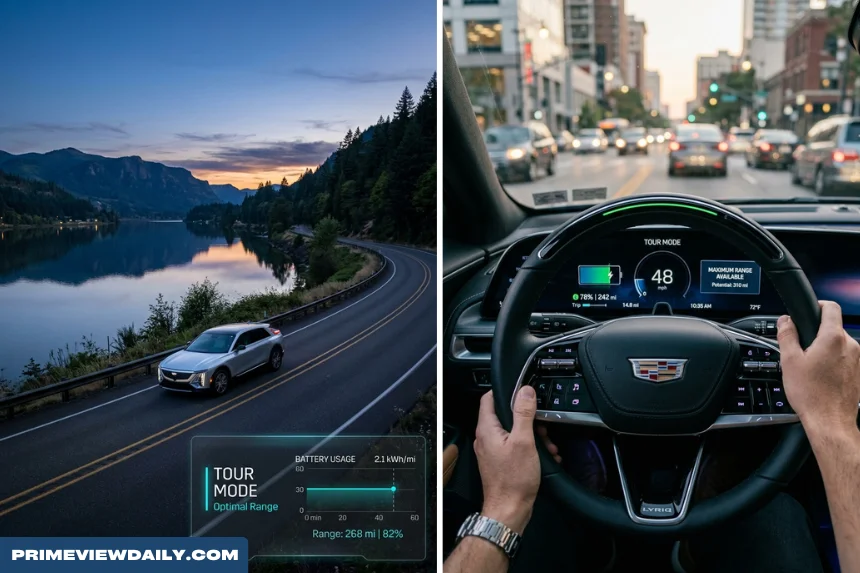
Tour is Cadillac’s normal city-and-highway setting. The manufacturer describes it as balancing a smooth ride, comfort, and handling rather than as a dedicated energy-saving mode.
Nevertheless, Tour is generally the best starting point for drivers who want predictable range. Its balanced accelerator response is less likely to encourage repeated bursts of power than Sport. Moreover, it works well for ordinary commuting, steady highway travel, and mixed driving.
Tour does not guarantee the maximum possible range. A driver traveling at high speed with strong cabin heating can consume more energy in Tour than a careful driver in Sport. Therefore, driving behavior remains more important than the name of the selected mode.
Is Tour the same as Eco mode?
No. The standard LYRIQ does not list a dedicated Eco mode in its official Driver Mode Control menu. Instead, Tour serves as the regular balanced setting, while My Mode allows the driver to select a relaxed acceleration feel.
Calling Tour an Eco mode may create the false expectation that it limits climate use, motor output, or maximum speed. Cadillac does not describe it that way.
Sport can increase consumption, but no fixed penalty exists
Sport Mode makes the LYRIQ more responsive rather than physically reducing its available battery. It modifies accelerator tuning, steering, sound, adaptive cruise behavior, and suspension settings when the relevant equipment is present.
Because the accelerator feels more immediate, drivers may request higher power more often. Rapid acceleration requires a larger short-term energy draw, and repeating those events reduces miles per kilowatt-hour. As a result, Sport commonly produces lower real-world range when it is used aggressively.
However, no authoritative source confirms claims such as “Sport reduces range by 10%” or “Sport always costs 30 miles.” Cadillac does not publish such figures because the result depends on speed, traffic, temperature, route, tires, elevation, and driver input.
At a steady cruising speed under similar conditions, the difference may be relatively small. Therefore, Sport’s biggest efficiency effect usually comes from how its more responsive tuning changes driver behavior.
Snow/Ice prioritizes control rather than battery savings
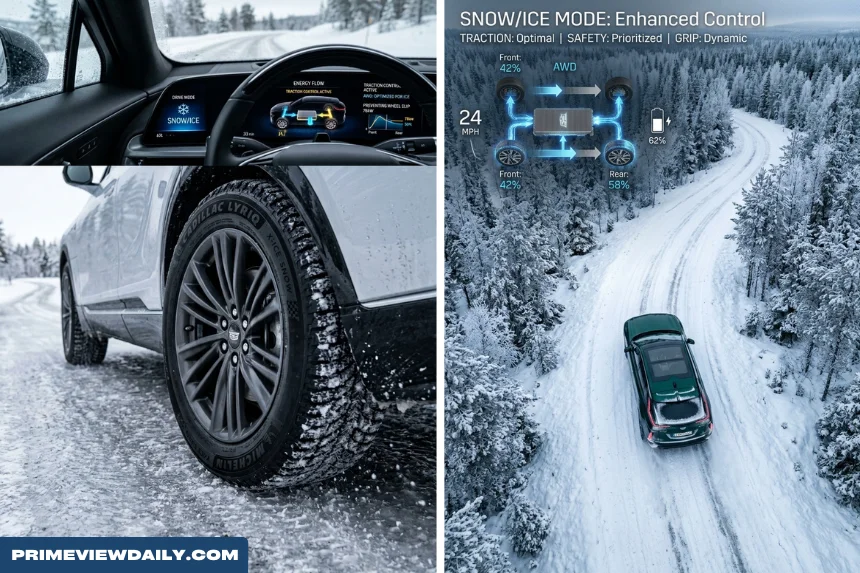
Snow/Ice Mode exists to improve traction on slippery surfaces. Cadillac says it changes pedal tuning and modifies the electric AWD system. It may also make acceleration feel less responsive on dry pavement.
The mode does not promise longer range. Moreover, winter driving normally combines several energy-intensive conditions:
- A cold battery
- Cabin heating
- Defroster use
- Increased rolling resistance
- Snow or slush on the road
- Lower tire pressure
- Reduced regenerative-braking capability when the battery is cold
Consequently, owners may notice higher battery consumption while using Snow/Ice. However, the weather and road surface may be responsible for more of the loss than the mode itself.
Safety should take priority. Selecting Tour merely to protect the range figure would not be sensible when Snow/Ice provides more appropriate accelerator and traction calibration.
My Mode depends entirely on its configuration
My Mode does not have one fixed efficiency level. It allows the driver to customize acceleration feel, brake feel, steering, suspension, and motor sound. Acceleration options may include Relaxed, Tour, and Sport.
A range-conscious setup could use Relaxed acceleration while retaining the preferred steering or suspension setting. That configuration may encourage smoother power delivery. However, Cadillac does not certify Relaxed My Mode as delivering more miles than Tour.
Conversely, selecting Sport acceleration and Sport suspension can make My Mode behave more like a performance configuration. Therefore, any battery effect depends on both the saved settings and the driver’s subsequent inputs.
What about the LYRIQ-V and V-Mode?
The 2026 LYRIQ-V is a separate high-performance model with dual-motor AWD, up to 615 horsepower in Velocity Max, and an EPA-estimated 285-mile range. Its lower official range compared with the standard LYRIQ reflects the complete vehicle’s performance-oriented hardware and configuration.
V-Mode lets owners save performance-focused preferences. However, selecting it does not instantly change the official rating or battery capacity. It simply enables the configured performance behavior.
Aggressive use of the additional output will consume energy more quickly. Nevertheless, drivers should not confuse the LYRIQ-V’s 285-mile model rating with a supposed “V-Mode range” that applies only while the mode is active.
Why can the displayed miles change?
The number of miles shown beside the battery gauge is a prediction. According to the 2026 Cadillac LYRIQ owner’s manual, the vehicle calculates it using recent driving habits, current conditions, ambient conditions, and HVAC use.
Therefore, estimated miles can fall even when the battery percentage changes only slightly. The vehicle is not necessarily losing stored electricity suddenly; instead, it may be predicting that the remaining electricity will cover fewer miles.
Similarly, the estimate can rise after a period of smooth, low-speed driving. This change does not mean the battery generated energy from nowhere. Rather, the estimator has recalculated the likely distance using more efficient recent data.
Drive modes and regenerative braking are separate systems
Several competitor pages treat regenerative-braking strength as part of each drive mode. However, Cadillac documents One-Pedal Driving and Regen On Demand as separate controls.
One-Pedal Driving lets the LYRIQ slow when the driver lifts the accelerator. Normal and High settings determine how strongly it decelerates. Regen On Demand uses the steering-wheel paddle to convert part of the vehicle’s movement back into stored battery energy.
Cadillac’s manual says One-Pedal Driving can recover more energy during coasting and braking than conventional Drive mode. Nevertheless, regeneration cannot recover all energy previously used for acceleration. Smooth driving and avoiding unnecessary speed changes remain more efficient than accelerating hard and relying on regen afterward.
Regenerative braking may also be limited when the battery is cold or nearly full. Therefore, a driver may feel less deceleration under those conditions even though the selected drive mode has not changed.
Factors that usually matter more than mode selection
The official efficiency guidance emphasizes several variables with a greater potential effect than simply selecting Tour or Sport.
Speed
Higher speeds increase the energy needed to overcome aerodynamic resistance. Cadillac’s manual specifically warns that higher vehicle speeds can significantly reduce electric range.
Therefore, driving at 75 or 80 mph in Tour can use more battery than driving at a moderate speed in Sport.
Acceleration and braking
Repeated rapid acceleration requires high power. Moreover, hard braking can waste energy when the vehicle must rely more heavily on friction brakes rather than regenerative braking.
Planning stops, maintaining traffic flow, and using gentle accelerator inputs generally provide more reliable gains than changing the mode alone.
Heating and air conditioning
The cabin climate system uses energy from the high-voltage battery. Cadillac notes that heating and air conditioning reduce the electricity available for driving. It also advises warming or cooling the vehicle while plugged in when practical.
Temperature
Cold weather affects the battery and increases heating demand. The U.S. Department of Energy also identifies freezing temperatures as a major source of EV battery drain and reduced range.
Terrain
Long climbs require additional energy. Descending can recover some electricity through regeneration, but the recovered amount will remain lower than the energy required to climb because no conversion process is perfectly efficient.
Tires and vehicle configuration
Low tire pressure, winter tires, larger wheels, heavy cargo, roof accessories, and towing can reduce efficiency. Similarly, RWD, AWD, and LYRIQ-V models carry different official range figures because their hardware configurations differ.
Best settings for different driving situations
| Driving situation | Recommended setting | Range guidance |
|---|---|---|
| Daily commute | Tour | Most predictable baseline |
| Long highway trip | Tour or relaxed My Mode | Maintain moderate, steady speed |
| Performance driving | Sport | Expect increased use if accelerating aggressively |
| Snow-covered roads | Snow/Ice | Prioritize traction over range |
| Personalized comfort | My Mode | Choose Relaxed acceleration for smoother inputs |
| Stop-and-go traffic | Tour plus One-Pedal Driving | Can recover energy during deceleration |
| Slippery or icy roads | Snow/Ice; consider disabling One-Pedal | Follow the owner’s manual’s winter-driving guidance |
| LYRIQ-V spirited driving | V-Mode | High output can increase consumption substantially |
How to measure the difference accurately
Do not compare only the dashboard’s estimated miles. Instead, conduct a controlled comparison:
- Select the same route with similar traffic and weather.
- Begin each run at a similar battery temperature and state of charge.
- Use the same climate settings.
- Maintain similar speeds.
- Reset the trip or energy-efficiency display.
- Record miles driven and average miles per kilowatt-hour.
- Repeat the route in the opposite direction to reduce elevation and wind bias.
- Complete several runs in each mode.
The result will describe your vehicle, route, and driving style, not every Cadillac LYRIQ. Nevertheless, it will be more useful than an unsupported internet claim that Sport always removes a fixed number of miles.
When a low range estimate may require attention
A lower estimate does not automatically mean the battery has degraded. First, review recent highway speeds, temperature, climate use, tire pressure, cargo, elevation, and average efficiency.
Also compare actual miles driven with the percentage of charge consumed. If consumption remains unusually high during mild weather and controlled driving, or the vehicle displays battery, propulsion, or charging warnings, contact a Cadillac service center.
A single range-estimator reading should not serve as a battery-health test. The estimate reflects predicted use, while battery health requires proper diagnostic information.
Frequently asked questions
1. Do LYRIQ drive modes receive separate EPA range ratings?
No. Cadillac publishes EPA range by vehicle and powertrain configuration, such as RWD, AWD, or LYRIQ-V. Tour, Sport, Snow/Ice, and My Mode do not receive individual mileage ratings.
2. Which mode is best for maximizing range?
Tour is the most sensible everyday baseline because it balances comfort and response. However, smooth acceleration, moderate speed, and restrained climate use matter more than the mode label.
3. Does Sport Mode always use more battery?
No. Sport makes acceleration more responsive, but the driver still controls how much power is requested. Nevertheless, frequent rapid acceleration in Sport will usually reduce miles per kilowatt-hour.
4. Does Snow/Ice Mode reduce range?
It does not have a published range penalty. However, the cold weather and difficult road conditions that require Snow/Ice often reduce range independently of the setting.
5. Can My Mode improve efficiency?
A My Mode configuration using Relaxed acceleration may encourage smoother driving. Still, Cadillac does not provide a separate efficiency or range figure for that configuration.
6. Does One-Pedal Driving increase LYRIQ range?
It can help recover energy during slowing and stop-and-go driving. However, it is a regenerative-braking feature rather than a drive mode, and its benefit depends on traffic, temperature, battery charge, and driving technique.
7. Why does the estimated range change while the percentage stays similar?
The miles figure is a prediction based on recent efficiency, road conditions, and HVAC use. Consequently, it may change without an equivalent immediate change in the battery’s state of charge.
8. Does AWD use more battery than RWD?
The official ratings differ by configuration. For 2026, Cadillac lists up to 326 miles for RWD and up to 319 miles for applicable AWD models, although exact range also depends on equipment.
9. Is the LYRIQ-V’s 285-mile rating caused by V-Mode?
No. The 285-mile figure applies to the entire LYRIQ-V model under EPA testing. V-Mode can encourage higher energy use, but it does not create a separate official rating.
10. Does a low displayed range mean the battery is damaged?
Not necessarily. Temperature, speed, HVAC use, recent driving, and terrain can lower the prediction. Persistent poor efficiency or vehicle warnings should be evaluated by an authorized service center.
Conclusion
Do the driving modes in Cadillac LYRIQ offer different ranges or battery usages? They can produce different real-world energy consumption, but they do not change battery capacity or provide separate official EPA ranges. In other words, do the driving modes in Cadillac LYRIQ offer different ranges or battery usages? They can affect real-world efficiency, but they do not change the battery’s physical capacity.
Tour offers the most predictable everyday baseline. Sport may drain the battery faster when its sharper accelerator response encourages hard acceleration. Snow/Ice prioritizes traction, while My Mode’s impact depends on its customized settings. Meanwhile, One-Pedal Driving and Regen On Demand affect energy recovery but operate separately from the main drive modes.
Ultimately, speed, driving style, temperature, HVAC use, terrain, tires, and vehicle configuration usually affect range more than the selected mode. Therefore, owners should monitor actual miles per kilowatt-hour rather than relying only on changes in the estimated-miles display.